Wong Fei-Hung 黄飞鸿

Wong Fei-Hung (黄飞鸿) was a real martial artist, physician and lion dance master from Guangdong who lived for nearly eighty years, spanning the twilight of the Qing empire and the first years of the republic. In life he was known in Guangzhou and Foshan; after his death he became the foremost hero of Hong Kong cinema: since 1949, more than a hundred films and series have been made about him, and the series itself entered the Guinness Book of Records as the longest in history. He has been played by Kwan Tak-Hing, Jackie Chan, Jet Li Lian-Jie and dozens of other actors.
Wong Fei-Hung was born in 1847 near Foshan, in Nanhai County, Guangdong Province (sources disagree on the exact date). His father, Wong Kei-Ying, was one of the "Ten Tigers of Canton" – celebrated masters of southern martial arts; Wong himself was not among the ten, and he is sometimes called "the tiger after the ten tigers." He began learning Hung Gar from his father at the age of five, and at thirteen he met the master Lam Fuk-Sin, who taught him the sling and the "Iron Wire" set.
In 1863 Wong opened a martial arts school in Guangzhou, and in 1886, after his father's death, the Po Chi Lam clinic (宝芝林). He was famous for his lion dance – in Guangzhou he was nicknamed the "King of Lions." According to Chinese sources, in 1888 General Liu Yongfu took him into the army as a military physician and chief martial arts instructor. Wong married four times; his last wife, Mok Kwai-Lan, married him in 1915, was some forty years younger, and outlived her husband by half a century – she died in Hong Kong in 1982. Among Wong's students were Lam Sai-Wing and Leung Foon – both became regular heroes of films about him. The end of his life was hard: one of his sons died in 1919, and in 1924 the Po Chi Lam clinic was destroyed during the suppression of the Guangzhou merchant militia rebellion. Wong Fei-Hung died on 17 April 1925; by one account, the family could not even afford a coffin. Today a museum named after him operates in Foshan.
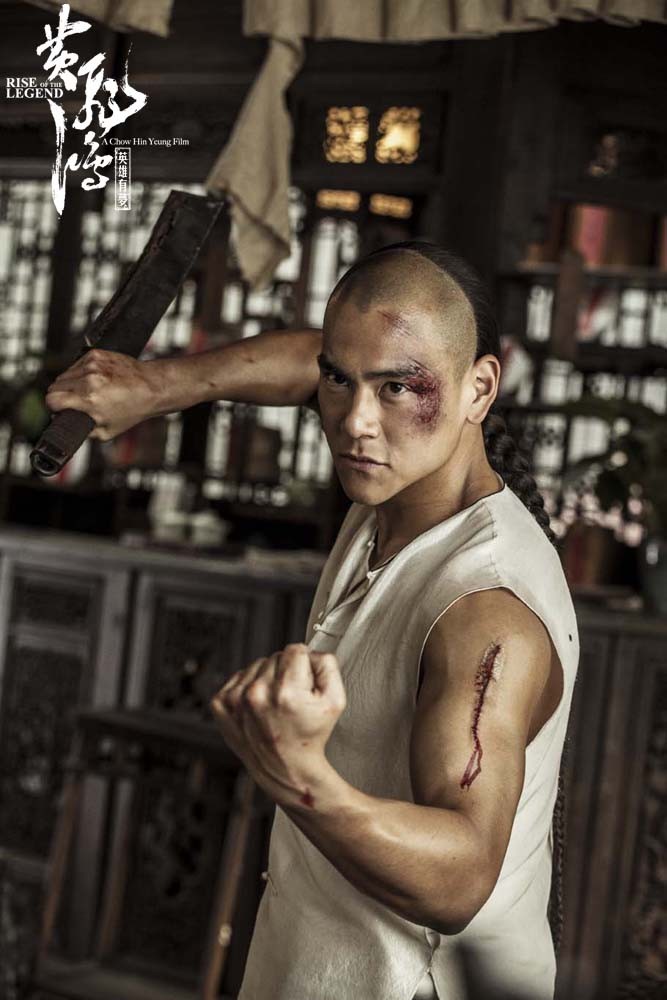
The cinema legend began with Wu Pang's film The Story of Wong Fei-Hung (Part 1) (1949), in which the master was played by Kwan Tak-Hing. The role became his life's work: by 1980 he had played Wong no fewer than 77 times (Chinese sources cite more than 80 films) – no one in cinema history has played a single person so many times. Shaw Brothers showed Wong in Martial Club (1981) by Lau Kar-Leung with Gordon Liu Chia-Hui, while Yuen Wo-Ping gave the role to Jackie Chan in Drunken Master (1978). The hero was given a new life by Tsui Hark: the Once Upon a Time in China cycle (1991–1997) numbers six films, with Jet Li playing Wong in four of them and Vincent Zhao in the fourth and fifth, after which he continued the role in TV series. The young Wong can be seen in Iron Monkey (1993), where he is played by Angie Tsang Sze-Man, and in Rise of the Legend (2014) the master was played by Eddie Peng Yu-Yen. Since the late 2010s, Wong has been a frequent hero of web films.
Kwan Tak-Hing was 44 years old in 1949, and for three decades Wong Fei-Hung remained for audiences a mature mentor, healer and head of a school. Later cinema turned ever more often to his youth – from Drunken Master and Iron Monkey to the series The Young Wong Fei Hung (2002) with Ashton Chen and the eponymous 2016 web film: on screen, the legendary master is increasingly only learning to become himself.