


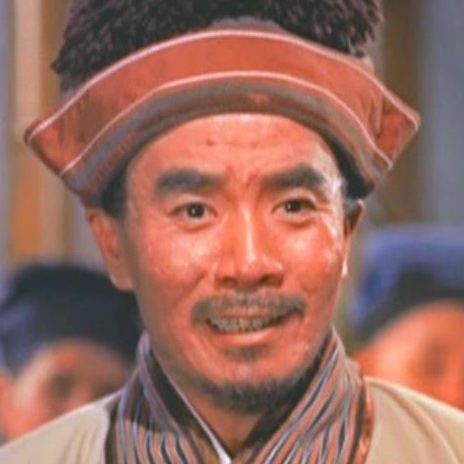
Yang Chi-Ching 楊志卿


At Shaw Brothers, Yang Chi-Ching worked both in front of and behind the camera. In the 1950s he assisted Li Han-Hsiang on Diau Charn (1958), in which he also played one of the conspirators at the imperial court. When swordplay films became the fashion, he was regularly cast as mentors, abbots and clan elders – men who had long wielded power in this world. From some of them a hero might seek help; others he had to overcome – like the Long-Armed Devil in One-Armed Swordsman (1967).
Yang Chi-Ching was born on February 11, 1919. Chinese biographical references give his birthplace as Longping County in what was then Zhili Province, on the territory of present-day Hebei. Hebei is also named in the biography that Celestial Pictures included on its DVD releases of Shaw Brothers films, while IMDb lists Hubei. Little is known about his parents and childhood. Yang began in the theater and got his first film roles in Shanghai. The studio biography dates his debut to 1941, and in 1942 came Compassion, one of his first pictures. At first Yang combined film work with the stage. In 1943 he appeared in both parts of the story of a Chinese opera actor's fate — in The Story of Qiuhaitang and The Story of Qiuhaitang (Part 2) — and in September 1944 his name appeared in a newspaper advertisement for the play Yun Caixia at Shanghai's Jincheng Theater.
After the war Yang continued to act in Shanghai. The studio biography states that in 1947 he joined Cathay. In The Lady Thief (1948) he played Zhao Dagang. In Female Prisoner No. 13 (1949), according to the Hong Kong Movie Database, he was already combining acting with the duties of assistant director. Celestial Pictures dates his move to Hong Kong to 1951, while Chinese references also mention 1952. He came to the Shaw brothers back in the days of Shaw & Sons, the company that produced films in Mandarin. The next three decades of his career were tied to Shaw. In Tomorrow (1953 according to the Hong Kong Film Archive, 1952 according to HKCinema) he played an investigator, and in Diary of a Husband (1953) a manager. He also appeared in Beyond the Grave (1954), a mystical melodrama about a living man's love for a ghost, based on a tale by Pu Songling. The Hong Kong Film Archive screened this early picture with Cantonese dubbing: such was the sound on the only surviving copy.
In 1958, Love with an Alien was released, featuring Yang — the first co-production between filmmakers of Hong Kong and South Korea. The film was shot in 1957. For decades the picture was considered lost, until in 2012 the Korean Film Archive received material from the studio for restoration. The soundtrack was gone, and at archive screenings the film was shown with subtitles. 1958 also saw the release of Diau Charn by Li Han-Hsiang, a musical based on an episode from Romance of the Three Kingdoms. Yang played the official Wang Yun, who, together with his adopted daughter, sets the all-powerful regent Dong Zhuo against his adopted son. On the shoot Yang also worked as assistant director. The film won five Asian Film Festival awards, including for directing.
Yang continued to appear in Li Han-Hsiang's films. In The Enchanting Shadow (1960), shown in the main competition at the Cannes Film Festival, he played Yan Chixia, a swordsman who knows what kind of evil spirits the visiting scholar is dealing with. Two years later, in Yang Kwei Fei, he was given the role of the chief minister Yang Guozhong, and in The Love Eterne (1963) the head of the school where the heroine enrolls disguised as a young man. The huangmei-style musical broke box-office records in Taiwan. According to Shaw, in three Taipei cinemas it ran for a total of 62 days. King Hu Chin-Chuan worked on The Love Eterne alongside Li — the Berlinale program lists him as co-director. When King Hu was entrusted with his own production, The Story of Sue San (1964), he too cast Yang Chi-Ching. Yang's wife, the actress Chen Yunhua, also appeared in this picture. The couple also appeared in another film of that same year, The Last Woman of Shang, where Yang played the king's adviser and Chen the queen.
In Come Drink with Me (1966), King Hu gave Yang the role of Abbot Liao Kung. Yang had already played a stern monk who separated lovers in Madame White Snake (1962). Liao Kung has a long-standing score to settle with the Drunken Cat, and it is the two of them who meet in the decisive duel. Just a year later, Chang Cheh cast Yang in One-Armed Swordsman (1967). The Long-Armed Devil and his men all but wipe out an entire school with a weapon that can trap an opponent's blade. And in King Cat, released the same year, Yang played Lu Fang, the eldest of the Five Mice.
Chang Cheh kept calling on Yang for films set not in the distant past but in the relatively recent one. In Vengeance! (1970), where the feud begins backstage at an opera troupe, Yang played Jin Zhi-Quan, one of the men the hero must settle accounts with. In Duel of Fists (1971), shot partly in Thailand, he appeared in a brief cameo as a former fighter. In those same years Yang acted in films about contemporary Hong Kong. In The Tea House (1974) and its sequel Big Brother Cheng (1975), Kuei Chih-Hung cast him in the same role – Fa Ta-Chu. Both films were based on a novel by Jiang Zhi-Nan about a tea house owner who fights the gangs with their own methods. The owner was played by Chen Kuan-Tai.
In the second half of the 1970s Yang worked especially often with Chor Yuen. In Killer Clans (1976), adapted from a novel by Gu Long, his Lu Man-Tien is part of the inner circle of Uncle Sun, head of the Lung Men clan played by Ku Feng. In The Sentimental Swordsman (1977) Yang played the monk Xin Mei, and in Full Moon Scimitar (1979) – Master Nan Gong. His collaboration with Li Han-Hsiang also resumed after the latter returned to Shaw Brothers following several years of work in Taiwan. In The Empress Dowager (1975) and The Last Tempest (1976), two dramas about the court of Empress Dowager Cixi, Yang played the same Qing official – Xu Tong.
In the early 1980s Yang was still working prolifically. In the supernatural film Bewitched (1981) he played a lawyer, and in Shaolin Prince (1983) – a tavern keeper. Between those two films Yang worked again with Li Han-Hsiang, in Passing Flickers (1982). The director gathered into the film stories he had heard or lived through over the years, from pranks on set to backstage love affairs. Yang, who had been at Shaw Brothers since its earliest costume productions, played in this film an actor who was given the role of Master Lu.
According to Chinese biographical references, Yang and Chen Yun-Hua had three daughters and two sons. The same sources say that both sons died before their parents, and that Chen Yun-Hua passed away in 1983. According to HKCinema and IMDb, Yang died on 30 April 1984 in Hong Kong. In September 2014 the Hong Kong newspaper The Sun, citing old film press, reported that the actor fell on 28 September 1984 and soon died in hospital. However, the author of that same item claimed that both deaths he wrote about occurred within a single week, and for the other he gave the date 26 April. Among Yang's last works was a small role as a villager in Opium and the Kung-Fu Master (1984). The last film with his participation, Disciples of the 36th Chamber, was released after his death, in 1985.




http://www.hkcinema.ru/actor/2286/gallery