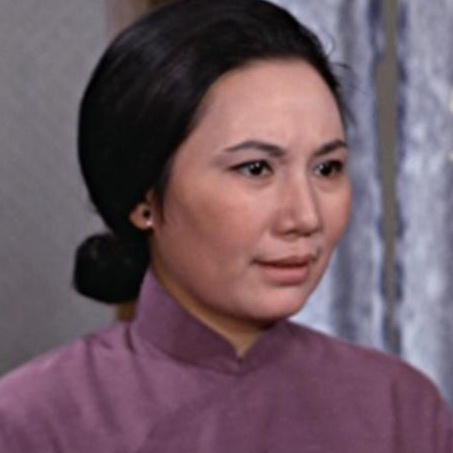
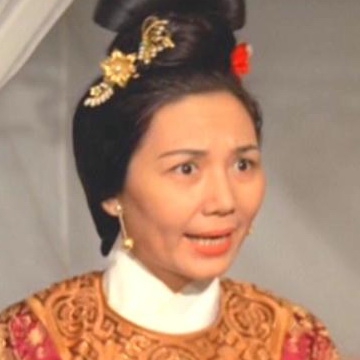
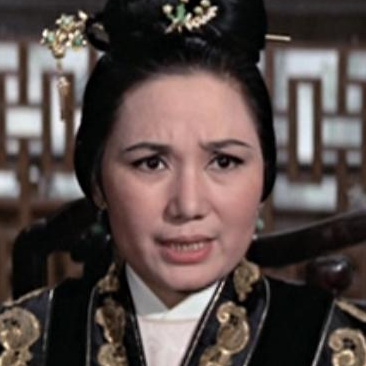
Kao Pao-Shu 高寶樹

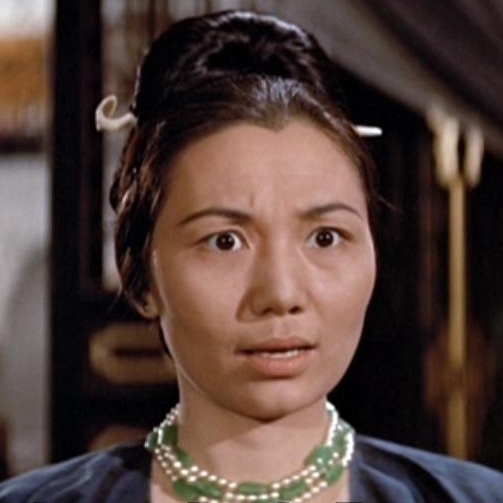
At a gathering of filmmakers in Taipei in January 1978, Kao Pao-Shu joked that she always celebrates her twentieth birthday, but when the talk turned to seniority, she insisted on being counted among the fifth generation of film actors. By then she had appeared in nearly eighty Shaw Brothers films, headed the studio's dubbing department, and founded her own production company. Kao was known for her roles as mothers and aunts, and now her name was appearing in the credits of action films she directed in Taiwan and Thailand. In the 1970s she was one of the few women regularly making Hong Kong martial arts films, and sometimes she acted in them herself.
Kao Pao-Shu was born in 1932 in China's Jiangsu province. According to a biography compiled by the Hong Kong Film Directors' Guild, her father, Gao Jianqing, earned the xiucai degree back in the Qing dynasty. The Guild gives only the year and province of birth. Later references cite a date of February 2 and name the birthplace variously as Suzhou or Suqian. According to the Guild, Kao was thirteen when her father died. The family grew poorer, and Kao had to leave the Xuzhou teachers' college. She found work as a reporter at the Zhengdao Bao newspaper in Bengbu, and then joined a drama troupe. A later publication on Sohu says that her father died in 1942, and that Kao herself studied at a Xuzhou middle school and worked in Su County. It was in the troupe that Kao met the actor Chiang Nan, her first husband.
In 1951 Kao moved to Hong Kong. Her roles were small, and she had to supplement her income as an announcer and by doing dubbing work. She signed a contract with the Yonghua studio in 1953. Two years later Kao moved to Hsin Hwa and went to Tokyo to shoot Blood Will Tell (1955). The producer took the crew there to learn colour filming. The Hong Kong Film Archive calls the picture the first Chinese film shot on Eastmancolor stock. Among the works of those years, Corpse-Drivers of Xiangxi (1957) is a curious one. Kao plays the mother of a girl whose romance her relatives threaten to bring before the clan council. Roles like this would often come her way later at the Shaw Brothers studio as well.
Kao joined Shaw Brothers in 1958 and appeared in nearly eighty of its films. In The Love Eterne (1963), made in the tradition of huangmei musicals, a student in disguise confides her secret to Kao's character and asks her to pass a jade pendant to her beloved. In Vengeance Is a Golden Blade (1969), Kao plays a woman who takes a lover from a rival escort agency and herself gives her husband poison. And in the melodrama A Place to Call Home (1970) she plays a dance-hall worker sought out by the daughter she gave up to an adoptive family. By then Kao was already supervising dubbing at the studio and working as an assistant director. In 1970 she helped shoot two very different pictures — the family drama The Younger Generation and the wuxia film The Twelve Gold Medallions.
Kao made her directorial debut at Shaw Brothers from a script by Ni Kuang. The Guild dates the work on the film to 1970, and Lady with a Sword opened in Hong Kong cinemas in October 1971. Feifei, played by Lily Ho, sets out to avenge her sister's murder and learns that the man she was betrothed to as a child had a hand in it. Her fiancé's family urges her to give up her revenge. The culprit's mother has her own truth, and she is ready to defend her son sword in hand. Kao paces such family scenes unhurriedly, and the duels grow out of conversations in which, until the very last, it seems an agreement might still be reached.
In 1971 Kao left Shaw Brothers and, together with her second husband, the producer Wengi Pak, founded the company Park Films. Their first independent picture, The Desperate Chase (1971), was shot in Taiwan with Jimmy Wang Yu and Lisa Chiao Chiao, who had also left the Shaw Brothers. After the contract was broken, the Shaw Brothers studio sued Jimmy Wang Yu, and he continued to make films in Taiwan. Kao worked again with Ni Kuang, and in the long final fight her hero, played by Jimmy Wang Yu, takes on an entire squad with a spear. American distributors re-edited and re-dubbed the picture, commissioned music from the rock band Flood, and released the film under the title "Blood of the Dragon." It was this version that was shown in 2019 at the New Beverly cinema in Los Angeles, alongside another of Kao's works.
She continued to act in her own studio's films, sometimes in very small bit parts. In The Cannibals (1972) she played a casino worker in a flashback episode. In her next picture, Win Them All (1973), about the gambling business, Kao gave one of the lead roles to the young Wong Yuen-San. As New Martial Hero magazine wrote at the time, she gathered journalists specially to introduce the actor. He had completed the joint Shaw Brothers and TVB courses and had already worked in action films, though at the studio itself, after several auditions, he never landed a role. In the middle of the following decade Kao called on him to act again, this time in a TV series.
By the mid-1970s Kao was increasingly turning to contemporary crime stories. She wrote the script for Female Fugitive (1975), a story about drug trafficking, together with Ni Kuang, and took one of the lead roles in the film herself. The Taiwanese cinematographer Lin Wen-Chin recalled how Kao invited him to Thailand to shoot the picture. It features both Hong Kong and Thai actors, and opium is carried out of the jungle on elephants. For Wrong Side of the Track (1976) she turned to the prose of Jiang Zhinan, whose books about the Hong Kong underworld were often adapted at the time. She shot The Damned (1977) in Taiwan. There the film was released under the title Three Thousand Silver Coins — the sum that goes to a coachman who gets mixed up in a robbery. In October 1978, at the Golden Horse ceremony in Taipei, Kao was among seven producers whom Taiwan's Government Information Office presented with special awards for their contribution to the development of cinema outside Taiwan.
Toward the end of the decade Kao played the mistress of an estate in her own film The Jade Fox (1979), and a year later she directed The Master Strikes (1980) from her own script. In this comedy Casanova Wong plays a guard who loses both the treasure entrusted to him and his mind. He picks fights with whoever comes to hand, and even his companions get a share of it. Tony Ching played one of these companions and choreographed the fights. An HKCinema review singles out the pole fight and the final bout. Wong himself, in an interview with Mike Leeder, also picked out this picture among his work — he remembered the shoot with Ching and the role of a man who goes mad as the story unfolds. In Seed of Evil, which the Guild dates to 1981 and HKCinema to 1980, Kurata Yasuaki got a role in a family drama, a rare one for him. Kao wrote the script herself and appeared on screen.
In the 1980s Kao moved to Taiwanese television. In the costume series Fei Hua Zhu Yue (1985) she again had Wong Yuen-San and Kurata in the cast. In December that year she told the weekly of the CTS channel that she had lost money on the production. She lacked experience in television, and the shoot had exhausted her, but she regarded the loss as payment for a lesson and expected to do better next time. In 1989, for another Taiwanese channel, TTV, Kao produced Xin Ti Xiao Yin Yuan from the novel by Zhang Hen-Shui. At Shaw Brothers she had once played a small role in an adaptation of the same novel, Between Tears and Laughter (1964). Kao died after an illness in July 2000. The Hong Kong Film Directors' Guild gives 20 July, while the New Beverly programme lists 23 July.