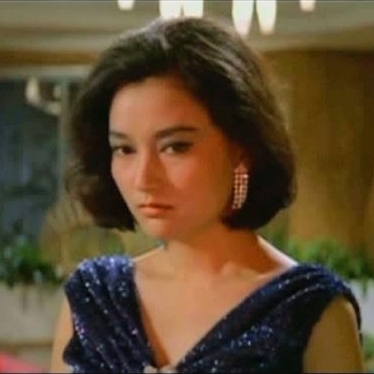
Julie Yeh Feng 葉楓


Julie Yeh Feng had a low, slightly husky voice that sounded equally good in speech and in song. The "Mysterious Stranger" she sings on the nightclub stage in The Iron Fist was later reissued on compilations of Hong Kong pop. At MP & GI, Yeh was readily given roles of women accustomed to attention and used to choosing for themselves whom to be with. In the wartime diptych Sun, Moon and Star (Part 1) and Sun, Moon and Star (Part 2), she played a student who draws the hero into the resistance movement and goes off to the front. At Shaw Brothers she was given the parts of a headstrong village girl in The Shepherd Girl and of the owner of a nightclub that serves as a front for drug dealers in Poisonous Rose. In 1969, when she was just past thirty, she stopped acting regularly.
Wang Jiuling, the future Julie Yeh Feng, was born in 1937 in Hankou, Hubei Province. The Hong Kong Film Archive gives only the year. Reference books list her birthday as October 19, while a letter from the actress quoted by the Taiwanese press gives the 19th day of the tenth month of the lunar calendar. In 1948 the family moved to Taiwan, where Jiuling attended secondary school. Later, while working in Hong Kong, she would travel to visit her sister in Tainan.
Her first chance to get into films came in 1954. In Taiwan she was selected by the American studio Universal, but the shoot never materialized. That same year she came to Hong Kong and, with the help of Li Han-Hsiang and Li Tsu-Yung, joined the Yung Hwa studio. There she was offered a role and given a cheque against her fee, but, by the actress's own account, the cheque bounced. Soon afterwards the studio closed. Two more companies negotiated with her, but nothing came of it beyond talk. She appeared on screen in 1957, when producer Sung Chi invited her to MP & GI.
In Our Sister Hedy (1957) Yeh played Helen, the second of four sisters, who is used to stealing suitors from the eldest. She spoke softly and carried herself with such composure that she seemed genuinely hard to surprise. The newcomer held her own opposite Jeanette Lin Tsui, who was given the role of Hedy. The picture won the top prize at the 1958 Asian Film Festival, and in 1959 the studio released Wedding Bells for Hedy. There Helen is already married, and now her husband is jealous of her over a wealthy client. In one scene she dances barefoot on a long bar counter. The 35mm print of the film is missing two reels, and in 2016 the Hong Kong Film Archive supplemented the screening with footage from a 16mm print and a brief summary of the missing scenes.
At MP & GI they knew how to devise roles to suit their actresses. In Sister Long Legs (1960) Yeh again played the sister of Jeanette Lin Tsui's character, this time a reserved schoolteacher who is self-conscious about her height. At around one metre seventy, Yeh stood out among her colleagues, and the director made a joke of it in a scene where she dances with a shorter partner. The tall Roy Chiao Hung was cast as the man with whom her character feels at ease. Another of Yeh's nicknames gave the title to Sleeping Beauty (1960). Yeh herself said she loved to sleep and, given the chance, was ready even to drink a glass of water lying down.
At first others sometimes sang for Yeh on screen. As the Apple Daily columnist Shen Xicheng recalled, one of the songs in The Wayward Husband (1959) was recorded for her by Pan Xiuchun. Around the same time, at a charity gala, Yeh sang "Autumn Night" from Bai Guang's repertoire. Later she signed a contract with Pathé. She had never trained in singing and, by her own account, when she was filming a great deal she was happy to leave the recording of songs to others. In The Iron Fist (1960) she performed Yao Min's song "The Mysterious Stranger" herself. In the musical comedy It's Always Spring (1962) Yeh likewise sang for her character. The Pathé record of songs from the film featured recordings by Yeh, Li Mei and Bei Lei.
Yeh's biggest work at the studio was the two-part melodrama Sun, Moon and Star (1961). The story begins before the war with Japan. The fates of three heroines are bound up with one man, played by Chang Yang, and each endures the war in her own way. The student Su Yanan, nicknamed Sun, sweeps him along with her, and in the second part, Sun, Moon and Star (Part 2), she herself goes on fighting at the front. Yeh and Chang grew close during the making of the picture. The Hong Kong Film Archive dates their marriage to 1961, although reports of the wedding appeared in the press as early as December 1960. In 1962, at the first ceremony of Taiwan's Golden Horse Awards, the picture was named Best Feature Film, while the Best Actress award went to Lucilla Yu Ming, who played Star.
Before Chang Yang, Yeh had been married to an Indian businessman and spoke to journalists about that marriage. The Taiwanese researcher of old cinema Su Tzu writes about the two children she had from her relationships with Indian men. She also recounts the newspaper story of how Yeh was courted by the basketball player Li Nan-Hui, a member of the Taiwan national team. In 1960 he spoke of their forthcoming wedding as a settled matter, and the announcement of Yeh's engagement to Chang came as a surprise to him. Li and Yeh traded recriminations through the press. Li claimed she had told him nothing, while Yeh replied that he had continued to see another woman.
According to the Hong Kong Film Archive, in 1962, when her contract with MP & GI ended, Yeh moved to the Shaw Brothers studio, the longtime rival of MP & GI. The National Museum of History of Taiwan gives 1964, the year her first films at the new studio were released. Yeh expected that she would be given big roles there. Li Han-Hsiang planned to cast her in an adaptation of Wang Lan's novel about the war years, but he himself left the studio. According to Shen Hsi-Cheng, Yeh turned down the role when it turned out that her part would be smaller than Lin Dai's. In Yeh's first Shaw picture, The Shepherd Girl (1964), the leads went to her and Guan Shan. He plays a fisherman, she a headstrong girl whom he does not even know at first. They hear each other from afar and converse in song. The shepherd girl's vocal parts were recorded by the singer Jing Ting. That same year, in The Warlord and the Actress (1964), scripted by Chang Cheh, Yeh played a performer from the Red Peony troupe who is pursued by a military governor.
While filming Pink Tears (1965), Yeh grew close to her co-star Ling Yun. In this picture she played a widow who suffers from a lung disease and supports her daughter. In July 1965 the Singapore newspaper Sin Chew Jit Poh was already writing about the break-up of Yeh and Chang. The press circulated rumors that the romance had begun before the couple's split. As Su Tzu writes, Chang, in filing for divorce, cited rumors of his wife's intimacy with Ling. Later he asked Taiwanese fans not to blame Yeh and said they had decided to divorce by mutual consent. Yeh said the problems in the marriage had begun long before this affair. According to Su Tzu, in Taiwan there were calls to boycott Pink Tears, and the film was pulled from release after three days. That same year Yeh married Ling Yun. Su Tzu writes that they had a son and a daughter, and that the couple divorced in 1983. According to the researcher, Yeh explained the break-up by saying that they were incompatible.
In Poisonous Rose (1966) Yeh again played a nightclub singer. The club serves as a cover for drug dealers with whom her character is involved. And in Unfinished Melody (1969) Yeh played a woman who, after her husband leaves, mistakes her doctor for him. The husband was played by Ling Yun, and the doctor by Guan Shan, with whom she also appeared in Farewell, My Love (1969). After this picture Yeh left the movies. In 1975 she appeared on screen once more, in a small cameo in Sup Sap Bup Dup, directed by Cecille Tong Shu-Shuen and produced by Jeanette Lin Tsui.
Having given up filming, Yeh went into business. In time she was reunited with Li Nan-Hui. In 2018 Shen Hsi-Cheng wrote that they were living together in Taiwan. Yeh returned to the stage only occasionally. In 2002 she performed at the Hong Kong Coliseum in a concert of old Mandarin songs. Among other things she sang a song from The Wayward Husband, which Pan Hsiu-Chiu had once recorded for her.