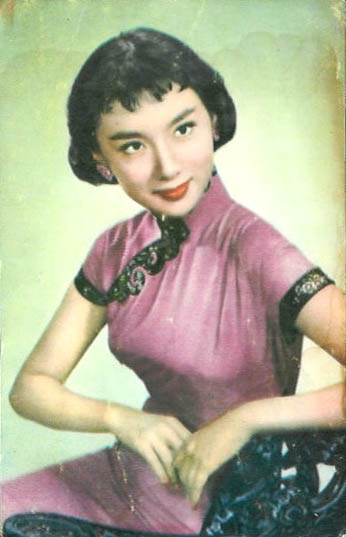
Hsia Meng 夏夢

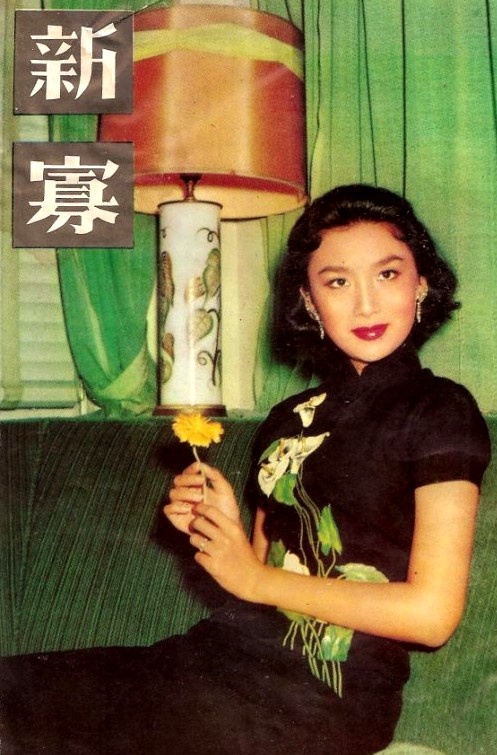
Hsia Meng rose to fame with her very first role and spent seventeen years acting at the Hong Kong studio Great Wall and its partner companies. Audiences grew used to seeing her as young wives and noble beauties, while in the opera comedy Bride Hunter she played a dandy who dresses up as a girl on a bet. After leaving the screen, Hsia Meng went into the garment business. She returned to cinema as a producer, taking on a drama about Vietnamese refugees that Ann Hui On-Wah wanted to direct. Of all the pictures Hsia Meng worked on, the one she valued most was Boat People.
Yang Meng was born in Shanghai in February 1933. The Hong Kong Film Archive gives 11 February, while the Hong Kong Commercial Daily cited the 16th. Biographical references also mention 16 February 1932. The Yang family came from Suzhou. Both parents were keen on Peking opera, and Meng was drawn to the stage from childhood. In Shanghai she attended the Zhongxi girls' school, and after the family moved to Hong Kong in 1947 she enrolled at Maryknoll Convent School. There she acted in amateur productions and was especially fond of Shakespeare.
The Great Wall studio stood near the family home, and Yang Meng often dropped by to watch filming. Her school friend Christine Mao recommended her to her father, studio head Yuen Yeung-On. In 1950 Yang Meng signed a contract with the studio, and director Li Pingqian gave her the lead in the comedy A Night-Time Wife. The film was released in 1951, though the English-language retrospective of the Hong Kong Film Archive lists 1952. The role of the young wife had been written for Li Lihua, who had by then left the studio. As the magazine Huanqiu Renwu wrote, the novice actress spent long stretches visiting an acquaintance couple, observing how they behaved at home. She later recalled that she stayed calm on set, even though she had never formally studied acting. A Night-Time Wife became the highest-grossing Mandarin-language Hong Kong film of the year. In the credits the actress appeared as Hsia Meng, meaning "summer dream". Her younger sister Yang Jie recalled how the two of them leafed through Shakespeare's plays looking for a name and settled on A Midsummer Night's Dream.
In her early years at Great Wall, Hsia Meng appeared in several pictures a year. To play a shop assistant in Day Dream (1953), she went to Hong Kong department stores to learn how to wrap purchases and write out bills. Once fans found out which store she was in, it became packed to bursting. That same year saw the release of Li Pingqian's The Peerless Beauty. Hsia Meng played a concubine of the ruler of the state of Wei who steals his military tally to help her native state of Zhao repel the Qin advance. The film's title became one of the actress's nicknames. In 1959 readers of Great Wall Pictorial voted her first among the stars of Mandarin-language Hong Kong cinema. Hsia Meng, Shi Hui and Chen Sisi were dubbed the three princesses of Great Wall in the press.
Great Wall and the Phoenix studio, for which Hsia Meng also worked, belonged to the left wing of Hong Kong cinema. In an interview with The Paper she recalled that her Great Wall contract did not require her to attend society receptions and dinners. She turned down offers to move to rivals, even when more money was dangled before her. One of the directors she worked with most often was Zhu Shilin. In his drama A Widow's Tears (1956) she played Fang Mei, whom her mother-in-law blames for her husband's death, and in Garden of Repose (1964), adapted from a novella by Ba Jin, she took the role of a stepmother vainly trying to raise a spoiled stepson. Hsia Meng played these women with restraint, even at the height of family quarrels. According to the Hong Kong Avenue of Stars, she received first-class individual awards from the Ministry of Culture of the PRC for A Widow's Tears and The Peerless Beauty.
On the set of her first film Hsia Meng met the actor Cen Fan. The newspaper Xinwen Chenbao later wrote that they were in love and parted when he left to work on the mainland. Cen Fan himself still recalled her with tenderness half a century later. Yang Jie, however, said her sister regarded him as a good friend. In 1954 Hsia Meng married Lin Baocheng, who worked for a trading firm. They had two daughters and a son.
The screenplay for The Peerless Beauty was written by Jin Yong, who worked in film under the name Lin Huan. The press claimed that Hsia Meng had served as the model for several heroines of his novels, and retold a story about a declaration of love in a coffee house. In 2014 People's Daily quoted the actress's assistant Liu Ren, who asked both Hsia Meng and Jin Yong about it. According to him, both denied that any declaration had taken place in the coffee house, though Jin Yong admitted he had been in love with the actress.
In the opera comedy Bride Hunter, which Jin Yong directed under the name Lin Huan together with Hu Siao-Fung, Hsia Meng played a man for the first time. In the Hong Kong Film Archive's screening programme the film is dated 1961, while an early archive catalogue and HKCinema give 1960. Her character, Zhou Wenbin, dresses up as a girl on a bet, and at the Lantern Festival he is abducted by a local bully who has decided to take the beauty as his wife. Audiences loved the picture, though Hsia Meng herself said years later that it lacked substance for her. Preparing for The Princess Falls in Love (1962) and My Darling Princess (1964), she went to Shanghai, where she studied operatic movement with yueju theatre performers.
In 1967, having finished shooting Oh, the Spring Is Here, which came out in the spring of 1968, Hsia Meng left with her family for Canada. By then the Cultural Revolution had made itself felt in Hong Kong through street clashes and a split among leftist filmmakers. According to the Hong Kong Film Archive's interview collection, Hsia Meng had opposed the Cultural Revolution from the start and, being pregnant, managed to avoid taking part in rallies and marches. Jin Yong responded to her departure with an editorial in his newspaper Ming Pao. He wished her a quiet life and defended a person's right to refuse to take part in political struggle. Two years later Hsia Meng returned to Hong Kong and went into the garment business. She later said she wanted to be remembered by audiences as young.
Hsia Meng closed her garment factory in 1978. In January 1979 Liao Chengzhi met with her and her husband and suggested she return to cinema. By the early 1980s Hsia Meng and her partners already had their own film company, Bluebird. The Hong Kong Film Archive dates its founding to 1979, the Hong Kong Avenue of Stars gives 1978, and The Paper says 1980. Refugees from Vietnam were arriving in Hong Kong at the time, and Hsia Meng chose precisely this subject for her first picture. She waited until Ann Hui was free and gave her and the screenwriters seven months to work on the script. In the first version the action took place mainly at sea, but shooting so many scenes on water proved too difficult. In Boat People (1982) the events are shown through the eyes of a Japanese photojournalist who returns to Da Nang and gradually learns what makes people flee post-war Vietnam. Andy Lau received one of his first major film roles here. After Hsia Meng's death he said that her decision to cast him in the picture changed his fate.
Boat People played to full houses in Hong Kong and won five Hong Kong Film Awards, including Best Film and Best Director. At the 1983 Cannes Film Festival the picture was moved at the last moment into the out-of-competition programme. The film was shot in Hainan and Zhanjiang with the cooperation of the Chinese authorities, and some critics felt it justified Beijing's position in the recent conflict with Vietnam. Hui responded that she had relied on the refugees' accounts and was making a story about how people try to survive. The director recalled that Hsia Meng gave her freedom in her work and handled the problems that arose after shooting herself.
For Bluebird, Hsia Meng produced two more pictures. First came Young Heroes (1983), an adventure film about teenagers pursued by emissaries of the Qing court. It was followed by Yim Ho's Homecoming (1984). The heroine comes from Hong Kong to her native village in Guangdong, where her childhood friends have remained. The picture won six Hong Kong Film Awards, including Best Film. There Hsia Meng stopped. As she explained in 2014, she was pleased with all three pictures, and no new idea ever came along that would have made her want to take up film again.
After she was widowed, Hsia Meng lived in Hong Kong and rarely appeared in public. In 2014 she travelled to Shanghai, where she signed a commemorative photo album for her fans. A year later, the Shanghai International Film Festival presented her with an award for her many years of contribution to Chinese-language cinema. She did not attend the ceremony for health reasons and thanked audiences in a recorded message. According to the Hong Kong Film Archive, Hsia Meng died in Hong Kong on 28 October 2016. Some obituaries gave 30 October as the date of death.