


The Sword and the Lute 琴剑恩仇
 7.0
7.0
7.0
 6.0
6.0
7.0


 7.0
7.0
7.0
6.0
6.0
7.0
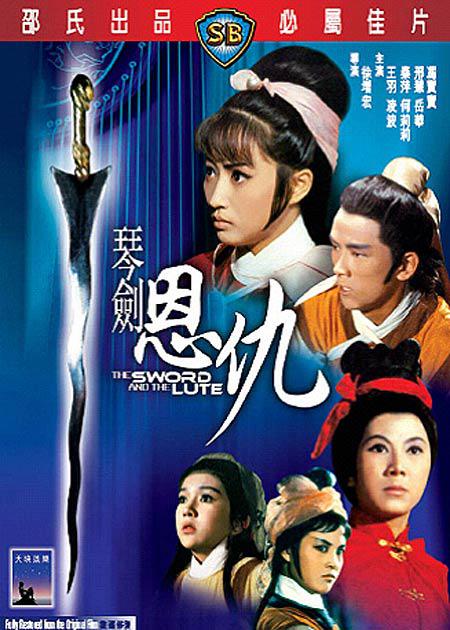
On their journey, Gui Wu (Jimmy Wang Yu) and his beloved Lianzhu (Chin Ping) wield the Deadly Lute, which showers their enemies with hundreds of needles. When the bandits of the Flying Tiger clan learn of the lute, they steal it and set their sights on the Seven Stars Stone – the only artifact that can heal the wounded son of the clan leader. Gui Wu and Lianzhu must stop them from achieving their goal and destroy the lute with the Invincible Sword.
The third (and final) film in the Temple of the Red Lotus trilogy, The Sword and the Lute shows just how far Hong Kong action cinema had come in only a couple of years – not that the threequel is head and shoulders above the original, but it is a fully fledged “wuxia” picture whose makers set the genre’s accents far more confidently and don’t shy away from action, letting it drive the plot. And while it would be a stretch to rank The Sword and the Lute among the major films of those years, this is one of those cases where each successive film in the cycle is better than the last.
The film features characters from the previous entries (Temple of the Red Lotus and The Twin Swords), so familiarity with the earlier parts would come in handy, especially since there are quite a lot of characters and for most of the running time they act independently of one another in separate groups, each pursuing their own goal. And although the plot is set in motion by the characters of Jimmy Wang Yu and Chin Ping, before long the characters of Petrina Fung, newcomer to the cycle Yueh Hua and Lo Lieh take centre stage – the latter anticipates John Woo’s trick from the sequel to A Better Tomorrow and plays the brother of his character from the first films, who was killed in The Twin Swords.
As far as the fight scenes go, The Sword and the Lute differs little from its predecessors – wuxia films of the second half of the 1960s have all dated in that respect. Nevertheless, good actors, a brisk plot laid out across several storylines and a light dose of healthy “fairy-tale” absurdity, without which this genre goes nowhere, keep you from getting bored. A particular pleasure is spotting the parallels with modern “superhero” cinema, which become especially obvious in the finale, when, as is the cycle’s tradition, the Red Lady, played by Ivy Ling Po, takes centre stage – an all-powerful “Captain Marvel” of sorts.
7.0
7.0
7.0
6.0
6.0
7.0

 7.0
7.0
7.0
6.0
6.0
7.0

