


Root in the Central Plains 根在中原
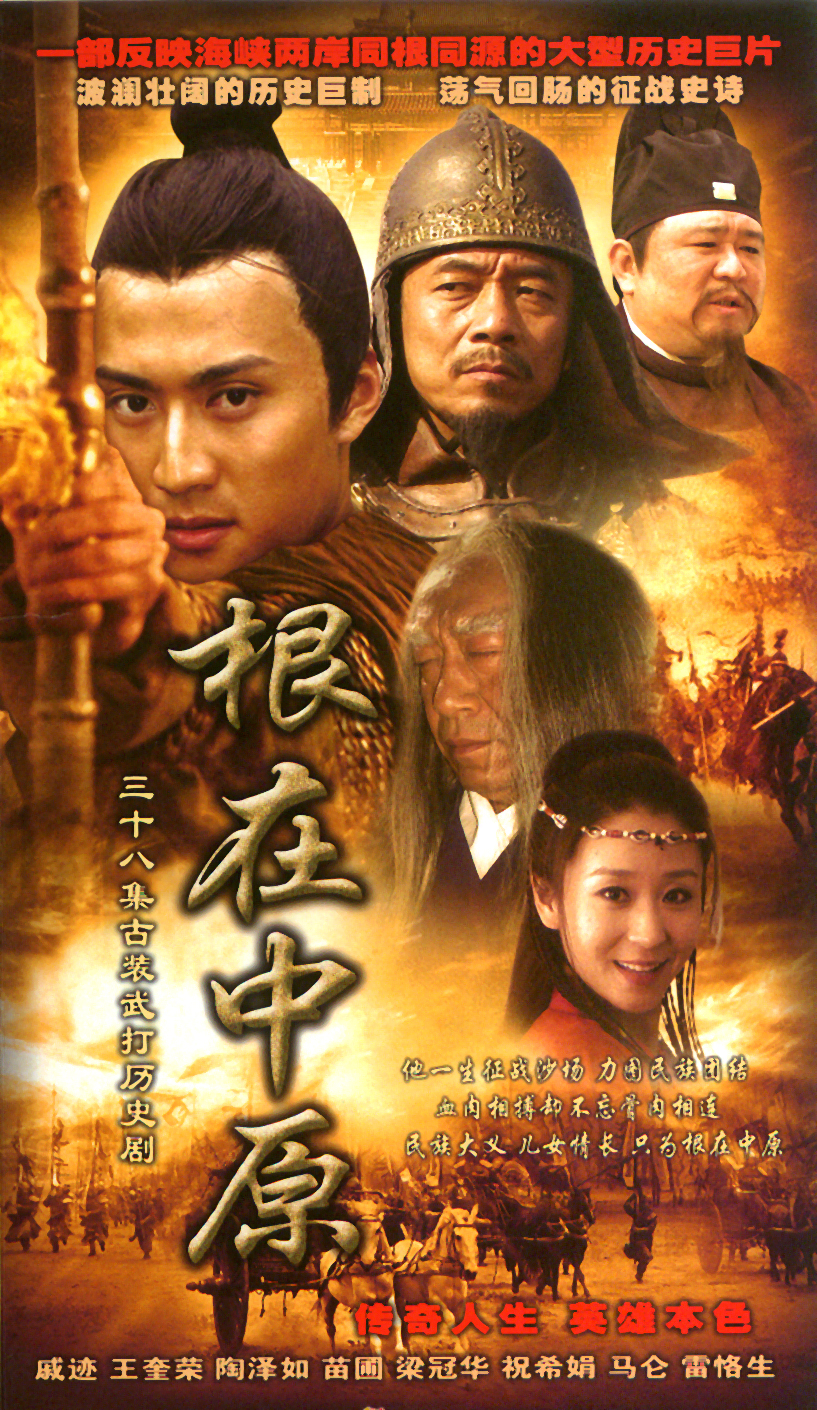

Chinese title (trad.):
根在中原
Chinese title (simpl.):
根在中原
Russian title:
Бунт на центральной равнине
Release year:
2008
Country:
China
Number of episodes:
38
Genre:
historical, drama
Language:
mandarin
Type:
TV series

Description:
The great Tang general Chen Yuan-Guang, accomplished in both letters and arms, served his country with unwavering loyalty. In his youth he followed his father on campaigns in southern Fujian, quelling the uprisings of the mountain Yue peoples. Two generations, father and son, transplanted the civilization of the Central Plains, pursued the integration of peoples, and brought lasting peace to the southern frontier. In 669 AD they petitioned the throne to establish Zhangzhou Prefecture — and so Chen Yuan-Guang entered history as the "Holy King Who Founded Zhangzhou." Show more
The descendants of Chen Yuan-Guang and his founding soldiers became the main population of Zhangzhou, Quanzhou, and the Chaoshan region, and continued to migrate to Taiwan, Hong Kong, and Southeast Asia. The cult of the "Holy King Who Founded Zhangzhou" became a culture of ancestral roots and remains one of the principal folk beliefs of our compatriots in Taiwan.
Successive emperors posthumously bestowed on Chen Yuan-Guang the titles of "Great General of Baotao, Defender of the State," "Marquis of Yingchuan," "Numinous, Responsive, Illustrious and All-Saving King," and "Marquis Zhaolie"; later the Qianlong Emperor named him "Holy King Who Founded Zhangzhou."
After Chen Yuan-Guang's death, his son Chen Xiang, his grandson Chen Feng, and his great-grandson Chen Mo successively held the post of prefect of Zhangzhou. Four generations, one after another, gave themselves wholly to building Zhangzhou for nearly a hundred years — a phenomenon exceedingly rare in the Tang dynasty.
After the Tang, migrants from Zhangzhou moved to Taiwan, settled there, and their numbers grew year by year without interruption for centuries, becoming the ancestors of many Taiwanese surnames.
To commemorate this "Holy King Who Founded Zhangzhou," temples were built for sacrifice in many places, with Zhangzhou as the source. And since the descendants of the Chen clan are scattered across Fujian, Guangdong, Zhejiang, Taiwan, the countries of Southeast Asia, and the world, people honor this ancient sage in many ways. Though General Chen Yuan-Guang has rested in peace for more than a thousand years, every year on the fifth day of the eleventh month, in the depths of southern Fujian's winter, Chen descendants and Zhangzhou natives from home and abroad gather at the mausoleum of Chen Yuan-Guang, the Holy King Who Founded Zhangzhou, on Shigu Mountain in Punan Township, Xiangcheng, to remember with deep reverence the great deeds and virtues of this ancient sage.
Worship of the Holy King Who Founded Zhangzhou, and the building of Weihui temples, is especially widespread among our compatriots in Taiwan. As Zhangzhou migrants crossed to Taiwan, temples were built across the island to offer incense to the Weihui temple of their homeland — by count, seventy-four of them.
Though General Chen Yuan-Guang founded Zhangzhou and achieved outstanding merits praised by all, his name does not appear in the New or Old Book of Tang. Yet in the annals of Fujian, and above all in the history of Zhangzhou's founding, he remains a hero whose brilliance will shine through the ages.
The monument to General Chen's merits stands firm in the hearts of the people — why beg the dry brush of historians to add luster to his name.
Following Chen Zheng and his son Chen Yuan-Guang to the lands of Fujian came soldiers of fifty-eight surnames from Guangzhou and Gushi, three thousand six hundred men. They settled there for good and likewise devoted their lives to Zhangzhou's development, becoming the forebears of many of the region's surnames.
Taiwan's roots lie in southern Fujian, and southern Fujian's roots lie in the Central Plains.

Movie crew
director:

script:
Actors







Actors
Do you know similar movies? Please recommend them or rate recommendations of others
Comments
Log in or register to leave a comment
Edit your comment
Add trailer
Link description
Link address
Recommend movies similar to "Root in the Central Plains"
Recommendations
* Don’t rate the movie, rate how similar it is to chosen one

