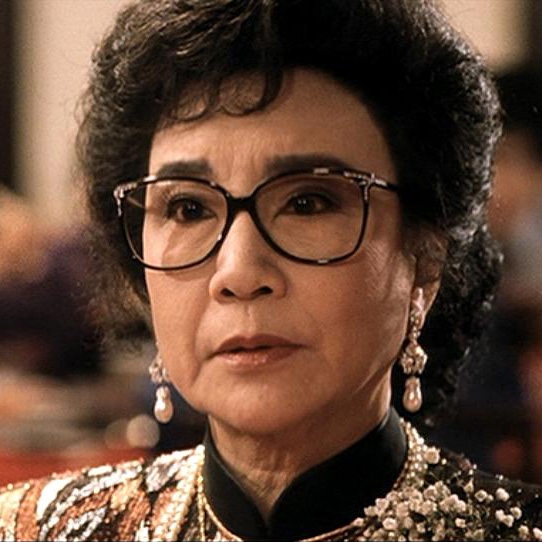
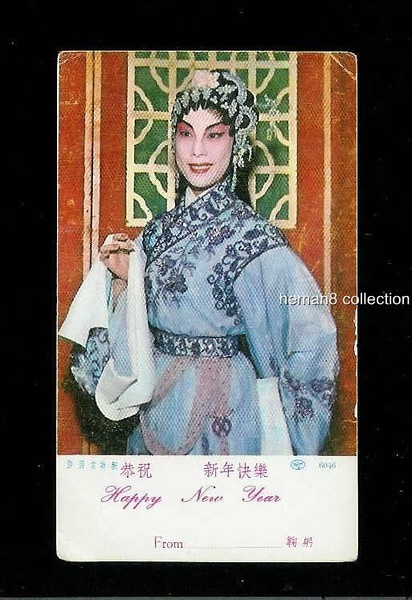
Tang Pik-Wan 鄧碧雲


Tang Pik-Wan came to Hong Kong cinema from Cantonese opera and brought part of her troupe's repertoire to the screen. She sang the roles of young heroines, played young men, and in comedies made use of the Cantonese dialects familiar to Hong Kong audiences. A new generation of viewers came to know Tang through television. In the series The Seasons she played the mother of a large family, the one people turn to for help when things go wrong at home. From her character the actress also acquired the nickname Ma-da.
Tang Pik-Wan was born on September 27, 1926, in Guangzhou. Her real name was Tang Chek-Fu (鄧芍芙). The family came from Sanshui in Guangdong Province. Her father served in the city police, and her maternal uncle headed opera troupes in the 1920s. The HKCinema profile and the reference guide of the University of Macau Library give 1924 as the year of birth. The Hong Kong Film Archive cites 1926, and that date is consistent with the recollections of Lui Oi-Yin, the actress's daughter. According to her, her mother died at 64. According to the Ming Pao Weekly, she was 66.
Tang studied singing with the composer Liao Liaoliao, and after moving to Hong Kong in 1937 she became a pupil of Tang Chiu Lan-Fong, a renowned performer of female roles in Cantonese opera. She began with small roles in the Tai Ping and Ninth Heaven troupes. In 1942, when Tang took refuge from the war in Macau, a role in an opera about Kuang Lai-Chun brought her fame. Tang was about sixteen when she began to be entrusted with leading female parts. In 1947, according to the Hong Kong Film Archive, she assembled her own troupe, the Pik-Wan Tin. The Chinese Opera Information Centre dates its founding to around 1949. One of the troupe's productions, The Gardener's Daughter, was adapted for the screen twice. In the first, The Gardener's Daughter (1950), Tang played To Shun-Yuet, and in 1960 she also appeared in the second Daughter of a Gardener.
Tang made her debut in Ciyun's Farewell in Storm and Fire (Part 1) (1950), based on an opera from her repertoire. In The Mad Monk by the Sea (1953) her partner was Ho Fei-Fan, with whom she had sung this opera on stage. Five years later both returned to their roles in a colour version of The Mad Monk by the Sea. In Two Sisters in Phoenix Bower (1954) she herself sang two songs in a low voice. Yuen Siu-Fai, who played her on-screen son, recalled that in manner her singing resembled the pop music of the day. Lui Oi-Yin also appeared in a small role. After the shoot Tang invited Yuen to join her troupe, where he received his first role in a major opera.
One of her most popular comic roles was the sharp-tongued heroine of A Fierce Debator (1956). In the sequel, The Saucy Girl's Sudden Rise to Power (1957), she travels to settle a family dispute, and when robbers cross her path on the way, she finds lodging in a haunted house. Tang knew well how people spoke in Shunde, Taishan and other corners of Guangdong, and readily made use of this on screen. In A Silly Girl Grabs the Bridegroom (1956) she speaks the local Shunde dialect from beginning to end. On the opera stage Tang sang both female and male parts. Male roles came her way in film as well. In the three-part Secret Book (1961–1962) she played Bai Yunfei, a princess who is a master of martial arts, wears men's clothing and travels with a tame crane, and in The Fake Lover (1963) she played both twins, brother and sister.
In 1959 and 1961, press polls named Tang "queen of huadan" (as the role of young heroines is called in Chinese opera). For the breadth of her repertoire she was nicknamed "the universal queen of huadan". By then she was already producing films herself. From 1953 to 1966, the three companies she founded — Po Po, Po Wa and Kam Pik — made, by the Hong Kong Film Archive's count, 46 pictures. The reference guide of the Chinese Opera Information Centre lists 39. Tang personally produced some of them, including The Gambler Who Pawns His Wife (1964) and A Wife's Diary (1965). Her husband, Lui Wai-Chau, handled the affairs of the opera troupe and took part in film production. The composer Lee Yuen-Man recalled that Tang's companies did not engage him for a long time because of his high fees. Later Lui himself invited him to write two songs for Meeting Mother in the Land of Death (1963). Tang sang one of them.
Tang kept performing on stage even when filming took up almost all of her time. In 1963 she took her troupe to Singapore and Malaysia, and in 1971 to the United States. To the young actress Cecelia Lee Fung-Sing, who could never quite stand out in ingénue roles, she suggested trying male parts, and later appeared alongside her, notably in Trouble in the Palace (1963). By the late 1960s Tang had almost stopped making films. According to the director of The Monkey Soldiers Come to the Rescue (1963), she left filmmaking to care for her ailing husband, and his production company closed down. Tang assembled her troupe for the last time in 1977.
Tang had begun acting for television as early as the turn of the 1960s and 1970s. In the second half of the decade she began appearing regularly and worked for all three Hong Kong channels. In the TVB family drama A House Is Not A Home (1977) she played the first wife of the family patriarch, and a year later she appeared in Chameleon on Rediffusion and in Celebrity Romance on Commercial Television. Audiences remembered her best as Lee Shuk-Tak from The Seasons. The series aired in the evenings on TVB from 1987, and in 1989 a sequel, Gam Jong Gwai Jit, was released. Tang's character managed the family finances and settled the quarrels of her grown-up children. The household nickname Ma-da, from the English "mother," quickly stuck to the actress herself. One of her co-stars recalled that she often treated her colleagues to food on set as well.
After the success of The Seasons, Tang landed new film roles. In the comedy Mother Vs Mother (1988) Tang played a woman who has to deal once again with a longtime rival when their children fall in love with each other. That same year, in Wong Jing's Mr. Possessed, she was given the role of the protagonist's mother, an arrogant rich woman accustomed to deciding everything for her son. In the HKCinema review her performance was singled out as one of the film's highlights. In Corey Yuen Kwai's action film She Shoots Straight (1990) Tang played the widow of a policeman who raised children that went into the police force one after another. Over forty years, by the film archive's count, Tang appeared in more than 280 films.
Lei Oi-Yin told the newspaper Wen Wei Po how her mother would come to her boarding school with breakfast after a night shoot. Lei would solemnly treat her classmates. At home Tang was thrifty: she brought home leftover food from receptions, and once she told her daughter to take back to the shop a fancy skirt her father had bought her. From the late 1950s Tang lived with her close friend Chan Han-Wan, whom she had met at the film studio. After Tang's death, in March 1991, Ming Pao Weekly asked Chan whether it was true that her friend had grown distant from the Cantonese opera stars Yam Kim-Fai and Pak Suet-Sin because she had put only 50 Hong Kong dollars in a New Year gift envelope. Chan denied the rumor. According to her, she and Tang stopped going to the couple's home for mahjong because they would sit down to play at two or three in the morning, and traveling at that hour was unsafe. When Tang was in the hospital, Pak sent her food every day.
In the summer of 1990 Tang injured her back on a trip to the United States. According to Chan, she was treated first there, then in Hong Kong, and was already on the mend when complications set in. Tang died on March 25, 1991, at Queen Mary Hospital in Hong Kong. This is the date given by the Hong Kong Film Archive and Ming Pao Weekly, while HKMDB lists March 21. Ming Pao Weekly cited respiratory failure as the cause of death. Colleagues from opera and film came to pay their last respects, including Jackie Chan and Chow Yun-Fat, and fans gathered outside the building. Tang's name is borne by a Hong Kong kindergarten and a center for the elderly that her family helped fund. On the thirtieth anniversary of the actress's death, the Hong Kong Film Archive screened eighteen of her pictures. The screenings ran from October 2021 to February 2022.