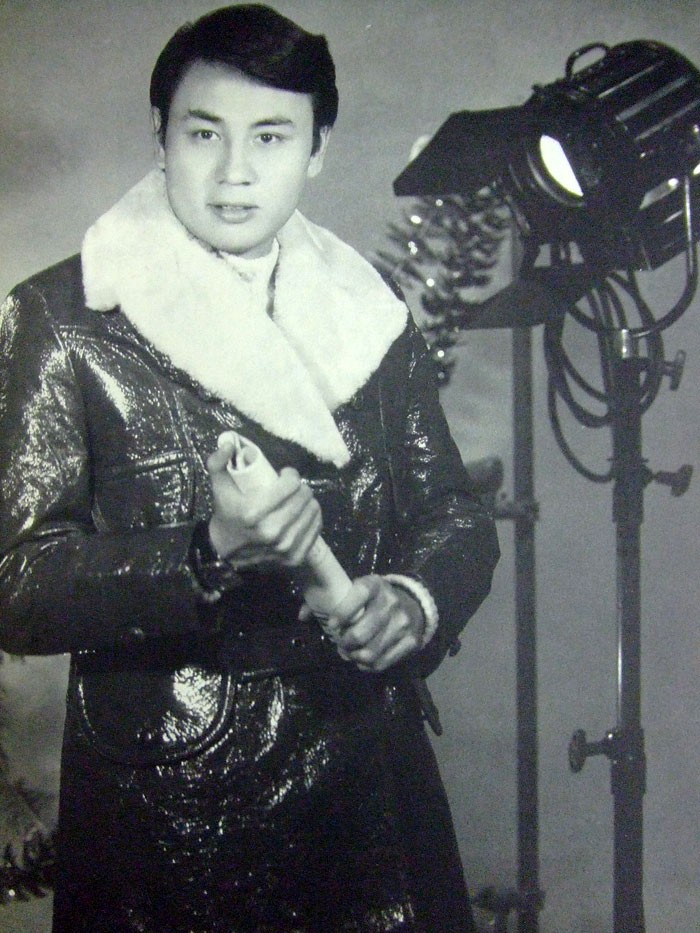
Tsung Hua 宗華


In Killer Clans, Tsung Hua plays Meng Xinghun, a hired assassin who wants to leave his trade behind. It is the best known of his roles at Shaw Brothers, where he played both swordsmen and heroes of melodramas. In Taiwan, Tsung Hua eventually began directing and producing series himself. He invited Hong Kong actors to appear in them, and together with Yang Li-Hua he succeeded in getting Taiwanese opera shown at eight in the evening.
Tsung Hua was born on April 2, 1944, in Hong Kong. His real name was Zou Zhongzhi (鄒忠智). The family came from Shandong. He was the youngest of the children. When he was two years old, his father died of illness. Tsung Hua grew up in Kaohsiung, Taiwan, and by his own account spoke Taiwanese more fluently than Mandarin in his youth. One of his older brothers, Zou Sen, also became an actor.
Tsung Hua performed in student theatre, and during his military service he travelled the island with an army troupe. In 1966 he won a prize for best acting at an all-army competition. In Taiwan he also tried his hand at cinema, appearing in Men of the Skies, a film about military pilots, with Ko Chun-Hsiung. In 1968 he returned to Hong Kong and joined the Shaw Brothers roster. One of his first jobs at the studio was the role of Lu Da in Chang Cheh's Return of the One-Armed Swordsman (1969). That same year he already had one of the lead roles in The Swordmates, and in The Golden Seal (1971) he played a young swordsman avenging his murdered father.
Tsung Hua first worked with Chor Yuen in 1971, when the director made Duel for Gold for Shaw Brothers. Two years later the director gave him the title role in The Bastard (1973). A foundling raised by a monk comes down from the mountains to find out who his parents are. On the road he is joined by a beggar girl, and the liveliest scenes in the film are the ones in which the two of them try to work out whom in this world they can trust. Tsung Hua also appeared in Chor Yuen's melodramas. In Lover's Destiny (1975) he played the student Fan Jiashu, in love with a street singer, and a year earlier, in Sorrow of the Gentry, one of the sons of a wealthy family.
Between swordplay films Tsung Hua also appeared in comedies. In The Warlord (1972), Li Han-Hsiang's satire on the era of the Chinese warlords, he played Wen San, who has an affair with the warlord's fourth wife. The warlord himself was played by Michael Hui. In The House of 72 Tenants (1973), Chor Yuen's Cantonese comedy about neighbours at war with their landlord, Tsung Hua had a small part as a rickshaw puller. As China Times wrote, in those years Shaw Brothers actors used to drop by his home for the spring onion pancakes his mother made.
His major work with Chor Yuen was Killer Clans (1976). Gu Long's novel was adapted for the screen by Ni Kuang. Tsung Hua's character, Meng Xinghun, takes on a mission that requires him to get close to the head of one of the clans, though he himself has long been weary of a life in which he must kill on other people's orders. Tsung Hua plays him with restraint, and in the scenes with Xiaodie, the clan leader's daughter, it is especially clear how much strength this man spends simply keeping his guard up. In his HKCinema review, Boris Khokhlov noted how much the film depends on its characters and on the old obligations that bind them. The picture took almost HK$1.6 million and, according to the Hong Kong Film Archive, was the seventh highest-grossing local film of 1976. After it, Chor Yuen went on to make a whole series of films based on Gu Long.
Tsung Hua began working behind the camera as early as the 1970s. In the year Killer Clans came out, he shot A Residence in the Mountains in Taiwan and acted in it himself. For a time he worked in both Hong Kong and Taiwan, and by the end of the decade he had moved to the island. He continued to appear in swordplay films, and in 1982 he again served as director and actor on Strange Skill. On television, too, he often appeared on screen at first. In Da Ming Ying Lie Hu Wei (1984) he was given the role of Qi Jiguang, the Ming general famed for fighting pirates.
For CTS he produced two series starring Petrina Fung in the lead. In Yang Gui Fei (1986) she played the favorite concubine of the Tang emperor Xuanzong, and Tsung Hua played the emperor himself. A year later, in Xi Shi, he was cast as the advisor Fan Li. Fung recalled that the invitation to Taiwan came at a difficult time for her. To another Hong Kong actor, Kenny Ho, Tsung Hua offered the role of the general Yue Fei in the series Ba Qian Li Lu Yun He Yue (1988), which he himself directed and produced. As Ho recalled in an interview with Ming Pao Weekly, it was his first job on Taiwanese television. Three years later he worked with Tsung Hua again, playing the title role in Shao Nian Zhang San Feng.
In 1994 Tsung Hua worked with Yang Li-Hua on Luo Shen. It was a gezaixi, a Taiwanese musical drama in which male roles are traditionally often played by women. Yang Li-Hua played the poet Cao Zhi, and Petrina Fung played Zhen Mi. Tsung Hua took part in writing the script and in the staging. Taiwanese television aired a gezaixi at eight in the evening for the first time. In the mid-1990s Tsung Hua stepped back from regular work and moved to the United States. As the China Times wrote, he was married twice. He married for the first time only at fifty, explaining that he had previously been caring for his mother. In the US he lived with his second wife, an American of Chinese descent.
At the invitation of the head of the FTV channel, Tsung Hua returned to Taiwan and played the head of a large family in the series Father and Son, which came out in 2011. His Taiwanese, which he had spoken so fluently as a child, had grown rusty over the years. One line, according to the actor, had to be repeated eight times, and so that he would tire less from the road, the channel put him up right above the soundstage. The five actors playing his children were already calling him father on set, and at the series presentation in July they officially recognized him as their adoptive father. Tsung Hua then burst into tears and told journalists about a girl from an army troupe, his first love. According to him, she left him before his departure for Hong Kong. She thought that once he became a movie star he would leave her himself. A few years later, mutual acquaintances told him that she had borne him a son. Tsung Hua told the China Times that he had asked her about it himself, and she said it was not true. He never met the boy he had been told about.
Tsung Hua then appeared in Feng Shui Family, which replaced Father and Son in FTV's evening slot. He worked with Yang Li-Hua again and directed one of the episodes of her television opera Loyalty and Righteousness (忠孝節義), which was shot back in 2017 and shown in 2019. According to a family statement, Tsung Hua died in his sleep on April 25, 2023, in Taiwan at the age of 79. Some press reports gave April 26 as the date of death. Petrina Fung flew in from Penang to say goodbye to him on the evening of May 9, on the eve of the ceremony. According to her, after Luo Shen she and Tsung Hua never saw each other again. At the ceremony on May 10, his widow was presented with an honorary citation from Taiwan's Ministry of Culture for his contribution to culture and the arts.