


Legend of the Dragon 龙的传人
 7.0



 7.0
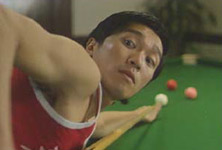
Stephen Chow plays Chow Siu-Lung, the son of the great kung fu master Chow Fei-Hung (Yuen Wah), who lives together with another of Fei-Hung's students, Mo (Teresa Mo), in the small town of Tai O and has never once ventured into the big city. But when Fei-Hung's brother (Leung Ka-Yan) comes to visit, Siu-Lung goes with him to Hong Kong to "see the world." He doesn't know that his uncle is up to his ears in debt, but since Chow is a magnificent billiards player, his uncle shamelessly exploits him, making money off him. Siu-Lung, of course, knows nothing about it — he never plays for money and thinks these are just ordinary "friendly" games, and everything changes only when he loses his father's land to a powerful mafia boss (Lung Fung), who has hired world billiards champion Jimmy White.
Impressions: Well, it's a fun little film on a topic rare for Hong Kong (and for the rest of the world, for that matter) — billiards. I wouldn't call it a classic, but it's a thoroughly worthy film in every respect: very solid direction (two men worked on the picture — Danny Lee and Lee Lik-Chi, later a frequent director of Stephen Chow's films), a few genuinely funny jokes, plus a knockout dose of action provided by old friends and colleagues Yuen Wah and Corey Yuen.
The funniest thing about the film is what we aren't shown. That is, the references to Wong Fei-Hung and Bruce Lee. You've probably already noticed the Fei-Hung one (that's the name of Yuen Wah's character), and there's also a funny scene referencing Once Upon a Time in China, which had only just appeared on screens at the time: Stephen Chow scatters attacking gangsters with an umbrella to the musical theme from that picture. The Bruce Lee bit is even funnier: Yuen Wah's character constantly claims that he was a colleague of that great master and even worked as his stuntman on several films, which is why he named his own son in his honor (Bruce's full name being Bruce Lee Siu-Lung).
The rest is less funny and at times grows tedious. All the scenes with Teresa Mo (a magnificent comedienne) are wonderful without exception, as are the actual billiards scenes, but everything else repeats itself far too often — some gags come twice and even three times, and as we all know, a joke repeated twice doesn't get any funnier. Leung Ka-Yan is genuinely hilarious, true, but there isn't as much of him as one would like, while Stephen Chow himself quite often starts to visibly overact.
But for the billiards, I'm ready to forgive anything! I love the game myself, and watching real professionals play was doubly interesting for me. Jimmy White is simply inimitable, and even Stephen Chow shows us a few quite difficult shots and combinations (though somewhere recently I heard that he lost some charity billiards match to a fellow star). The end credits hold the best part, when White pots an extremely difficult ball that became the key one in the film's final match (in the picture itself, naturally, it's Chow who pots it).
7.0
7.0

