


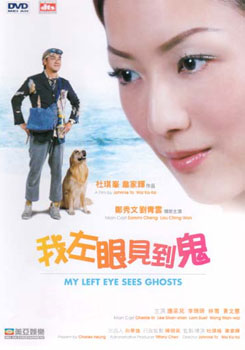
My Left Eye Sees Ghosts 我左眼见到鬼
Screenplay:
 7.0
7.0
Acting:
7.0
7.0
Visual side:
 9.0
9.0
Music:
7.0
7.0
Overall rating:
7.0
7.0

Sammi Cheng Sau-Man in movie «My Left Eye Sees Ghosts»

Sammi Cheng Sau-Man in movie «My Left Eye Sees Ghosts»

Sammi Cheng Sau-Man in movie «My Left Eye Sees Ghosts»

Борис Хохлов
February 26, 2003 at 14:06
4 / 1 968
Screenplay:
7.0
7.0
Acting:
7.0
7.0
Visual side:
9.0
9.0
Music:
7.0
7.0
Overall rating:
7.0
7.0
Борис Хохлов
February 26, 2003 at 14:06
4 / 1 968
May Ho (Cheng) married the millionaire Daniel just seven days after they met, and a few months later he dies tragically during a scuba diving trip. Daniel's family is inconsolable, and only May seems almost glad that things turned out this way — she quickly moves into her late husband's house, refuses to work, and spends her days doing nothing at all — except, of course, when she is shoplifting small items. Three years pass, after which May gets into a car accident, having drunk herself behind the wheel into unconsciousness. Crashing into a wall, she dies, but a hyperactive ghost named Ken (Lau Ching-Wan) forces her back into her own body. Now May is alive again, but after the injury her left eye has begun to see ghosts.
Impressions: Lately, Johnnie To and Wai Ka-Fai's good films have alternated with outright duds — not commercially (that side of things is fine), but artistically. After the brilliant Wu Yen, they could think of nothing better than to make the wretched Fighting for Love and Love on a Diet, but now they seem to have gotten back on the right track. Their new film with the long title My Left Eye Sees Ghosts, though it doesn't measure up to Wu Yen on any count, at least shows signs of improvement. The lapse in judgment turned out to be temporary.
Sammi Cheng, without much embarrassment, plays increasingly shrewish characters. If in Summer Holiday her behavior merely got on one's nerves a little, then in My Left Eye for the first half of the film it's hard to feel any sympathy for her at all — such a nasty girl inspires no affection whatsoever. She is rude to her late husband's relatives, spurns their gestures of reconciliation, ignores their attempts to make peace and find common ground, and after Daniel's sister (Cherry Ying) admits that she loves her anyway, despite her behavior, she robs her without a trace of embarrassment a second later. Quite the flirt.
But Sammi Cheng is Sammi Cheng, and not some Miriam Yeung, able to carry even such a "dead" role — dead in terms of winning the audience's sympathy — on her charm alone; there is enough nuance and truthfulness in her performance to make one believe in Mei's transformation over the course of the film. The other thing is that Sammi has to "carry" the film almost entirely on her own — the script is overlong and, though it comes together by the finale to stun the viewer with an unexpected and touching turn of events, it is considerably "smeared," as if to pad the running time the filmmakers could think of nothing better than to pour more melodramatic "water" into the plot.
Lau Ching-Wan does his best to help her, but his role is far more one-dimensional and passive, and besides, the manipulativeness and excessive sentimentality to which Johnnie To has never been indifferent are tied precisely to his character — an infantile ghost who behaves like a child. A certain "chemistry" between him and Sammi Cheng is of course present, but Cheng's role is far "meatier" and brighter, which is why Lau is every so often decisively shoved into a corner.
The ending, unfortunately, cannot be called an unequivocal success either. It has everything it needs — a sweet idea, an interesting treatment of it, plot threads clearly tied together — but the directors couldn't stop in time, which is why a strong first impression ends up smeared by an unnecessary "spreading of thought over the tree" of subsequent events. A wonderful title song (performed, naturally, by Sammi Cheng), quality cinematography and decent special effects are no rarity these days, so for it to truly stick in the memory, My Left Eye turned out too uneven. But, as was said above, it is far better than the films To and Wai Ka-Fai churned out before it.
Screenplay:
7.0
7.0
Acting:
7.0
7.0
Visual side:
9.0
9.0
Music:
7.0
7.0
Overall rating:
7.0
7.0
Sammi Cheng Sau-Man in movie «My Left Eye Sees Ghosts»
Sammi Cheng Sau-Man in movie «My Left Eye Sees Ghosts»
Sammi Cheng Sau-Man in movie «My Left Eye Sees Ghosts»
Screenplay:
7.0
7.0
Acting:
7.0
7.0
Visual side:
9.0
9.0
Music:
7.0
7.0
Overall rating:
7.0
7.0


Но упаси призрак-хранитель пересматривать.