


Sigh Of His Highness 一生为奴
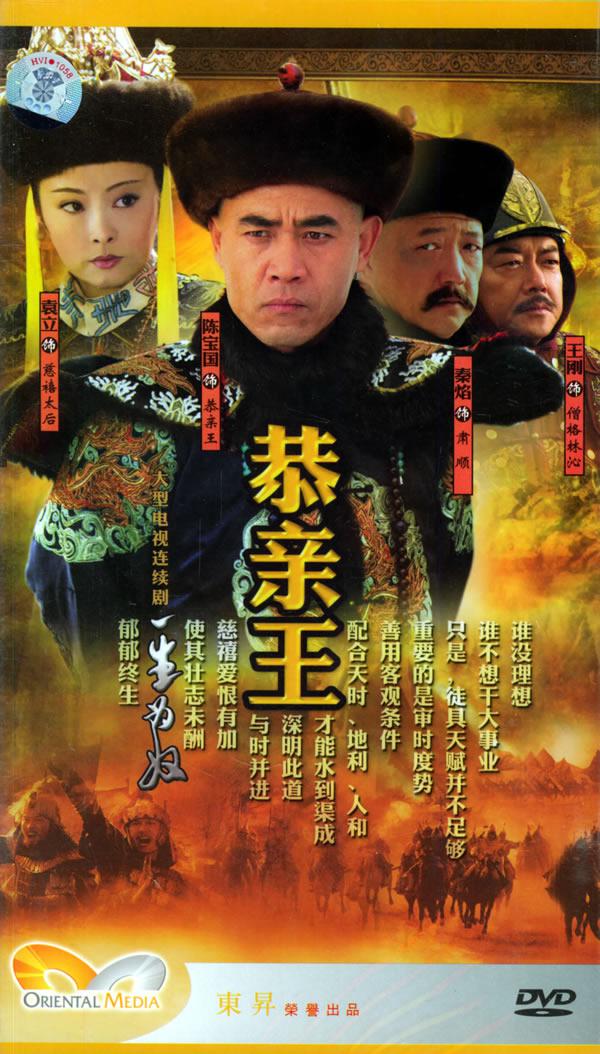

Chinese title (trad.):
一生為奴
Chinese title (simpl.):
一生为奴
Russian title:
Вздох его высочества
Other titles:
恭親王傳奇 (恭亲王传奇); 一生為奴 (一生为奴)
Release year:
2005
Country:
China
Number of episodes:
42
Genre:
historical, drama
Language:
mandarin, cantonese
China release date:
Type:
TV series

Description:
Yi Xin lived through the reigns of four emperors (Dao Guang, Xian Feng, Tong Zhi and Guang Xu) and one empress (Ci Xi), and both official and unofficial histories contain a great many records of him. Called to duty in a time of crisis, he entered the Grand Council at the age of twenty. Soon after his birth he lived through the Opium War, and over half a century he was deeply involved in almost every major event. Going along with history, he promoted the Self-Strengthening Movement, several times steered the political situation and averted crises, but the great edifice of the Qing Empire was already tottering, and all his efforts turned into an elegy and a lament. Show more Yi Xin's life unfolds the whole history of the late Qing.
In Yi Xin's life he several times came within a single step of the highest power (the imperial throne), yet was repeatedly demoted and censured; this intense drama laid the foundation for turning the series into an epic "palace" drama.
(1849–1855) When Emperor Dao Guang secretly decided on the succession, he hesitated between his fourth son Yi Zhu and his sixth son Yi Xin. Thus Yi Xin and Yi Zhu began a contest for the right of succession. Though this contest was not as bloody as in the last years of Kang Xi, it was extraordinarily fierce. Its outcome was an edict unprecedented in Qing history, a single box containing two decrees: "Appoint the fourth son of the emperor, Yi Zhu, as crown prince" and "Enfeoff the sixth son of the emperor, Yi Xin, as prince." During this time he married Gui Liang's daughter as his consort.
When Xian Feng ascended the throne, he followed the testament and enfeoffed Yi Xin as Prince Gong. Yi Xin left the palace to live in his own residence, where he remained for more than forty years.
From then on, the rise and fall of Prince Gong's residence was bound up with the decline of the great Qing dynasty.
In the third year of Xian Feng's reign, Yi Xin broke with precedent and joined the Grand Council, displaying his talents to the full. This was the honeymoon period in the political relations between Yi Xin and his fourth brother, Emperor Xian Feng; and it was precisely during this brotherly political honeymoon that Yi Xin had a fateful romantic encounter with the woman who later became Empress Dowager Ci Xi. By the fifth year of Xian Feng's reign, Yi Xin's mother had died, Yi Xin fell under suspicion and was expelled from the Grand Council, and the honeymoon came to an end. In the eighth month of the tenth year of Xian Feng's reign, Anglo-French forces pressed toward the outskirts of Beijing, and Xian Feng fled in panic to Rehe, issuing a special decree before his departure appointing Yi Xin "imperial commissioner with full discretionary powers to handle the peace." Whether he succeeded or not, Yi Xin might become the scapegoat. Accepting responsibility in a time of crisis, he endured humiliation and, with superhuman courage and political wisdom, signed the Beijing Treaty, forming a political group with Wen Xiang, Gui Liang and Bao Yun. This gave him the opportunity to re-enter the center of power at the Qing court. Until Xian Feng's death, although Xian Feng's testament named the crown prince Zai Chun as heir and appointed Su Shun and seven other ministers as regents to assist Zai Chun, Yi Xin, as a prince of the near imperial line, was not among the regents. But with his superb strategy and decisiveness, Yi Xin joined forces with Ci Xi, launched the breathtaking Xinyou Coup and won. His relationship with Ci Xi entered a very delicate phase.
The four years after the Xinyou Coup were the brilliant chapter of Yi Xin's political life. He simultaneously held the posts of Prince-Advisor, senior Grand Councilor, Grand Minister of the Zongli Yamen, head of the Imperial Clan Court and chief minister of the Imperial Household, effectively holding all power both inside and outside the court. Emotionally he kept Ci Xi at arm's length, while spiritually he controlled her. Had he wished to take the throne for himself at this time, he would have had the chance. This was his second opportunity to approach imperial power; why he gave it up has become an age-old mystery that has cost historians much speculation. This series sets out to unveil this breathtaking struggle.
Yi Xin gave up the chance to seize imperial power and, using the authority in his hands, reorganized the Grand Council, managed foreign affairs, promoted Han officials (Zeng Guofan and others), launched the Self-Strengthening Movement, and established modern military industry, railways, telegraphs and machine manufacturing. This produced what historians call the Tongzhi-Guangxu Restoration. At the same time, relying on his temporary omnipotence, he began a city-toppling love affair with Yu Er, the adopted daughter of the disgraced minister Su Shun.
A few years later, Ci Xi gradually changed her isolated and weak position, and the growth of Prince Gong's power and his love affair with Yu Er aroused Ci Xi's suspicion and jealousy. She secretly encouraged the court diarist Cai Shouqi to submit a memorial impeaching Yi Xin for greed, arrogance, abuse of power and favoritism, and Ci Xi seized the opportunity to order Yi Xin stripped of all his posts. This caused an uproar throughout the court; although the princes and ministers pleaded for him and his posts in the Grand Council and the Zongli Yamen were restored, his title of Prince-Advisor was still taken away. From then on Yi Xin felt that he "could no longer serve as before." By the time of Tong Zhi's personal rule and Guang Xu's accession, several decades had passed, and Yi Xin went through several more rises and falls. Although in the troubled times of the late Qing he several times tried to turn back the raging tide, after repeated failures his spirit was greatly dampened. In the contest with Ci Xi over political power and in the entanglement of their feelings, she gradually gained the upper hand and he was defeated. Until the tenth year of Guang Xu's reign, when France used the Vietnam question as a pretext to start a war, the indecision of the Grand Council led by Yi Xin caused the Chinese army to retreat again and again, and Ci Xi seized the opportunity to order the Grand Council dissolved, Yi Xin stripped of all posts and sent home to recover.
For the next ten years Yi Xin lived in seclusion in Prince Gong's residence. Though outwardly he did not meddle in politics, passing the years collecting antiques, practicing calligraphy from steles, writing poems and painting, he still paid attention to affairs of state, but gradually lost all his drive. In the twentieth year of Guang Xu's reign the Sino-Japanese War broke out, and he made his last comeback, but achieved nothing more; in the twenty-fourth year of Guang Xu's reign he died of illness. At that time a new wave of political storms (the Hundred Days' Reform) was already brewing.


Movie crew
director:


presenter:
Shu Zhan, Li Ming, Zhao Yi, Guo Chang-Jian

 23 m.
Shu Zhan
23 m.
46 m.
Li Ming
1 m.
Zhao Yi
1 m.
Guo Chang-Jian
producer:
Chen Wen-Guang, Chen Tan-Wen, Ling Li, Zhong Li-Fang, Zou Xiao-Li, Wang Man-Lin
71 m.
Zou Xiao-Li
8 m.
Chen Wen-Guang
1 m.
Chen Tan-Wen
1 m.
Ling Li
1 m.
Zhong Li-Fang
71 m.
17 m.
Wang Man-Lin
script:
cinematographer:
lighting:
props:
Actors
















Actors
Do you know similar movies? Please recommend them or rate recommendations of others
Random photos


Comments
Log in or register to leave a comment
Edit your comment
Add trailer
Link description
Link address
Recommend movies similar to "Sigh Of His Highness"
Recommendations
* Don’t rate the movie, rate how similar it is to chosen one

