


Kangxi 康熙
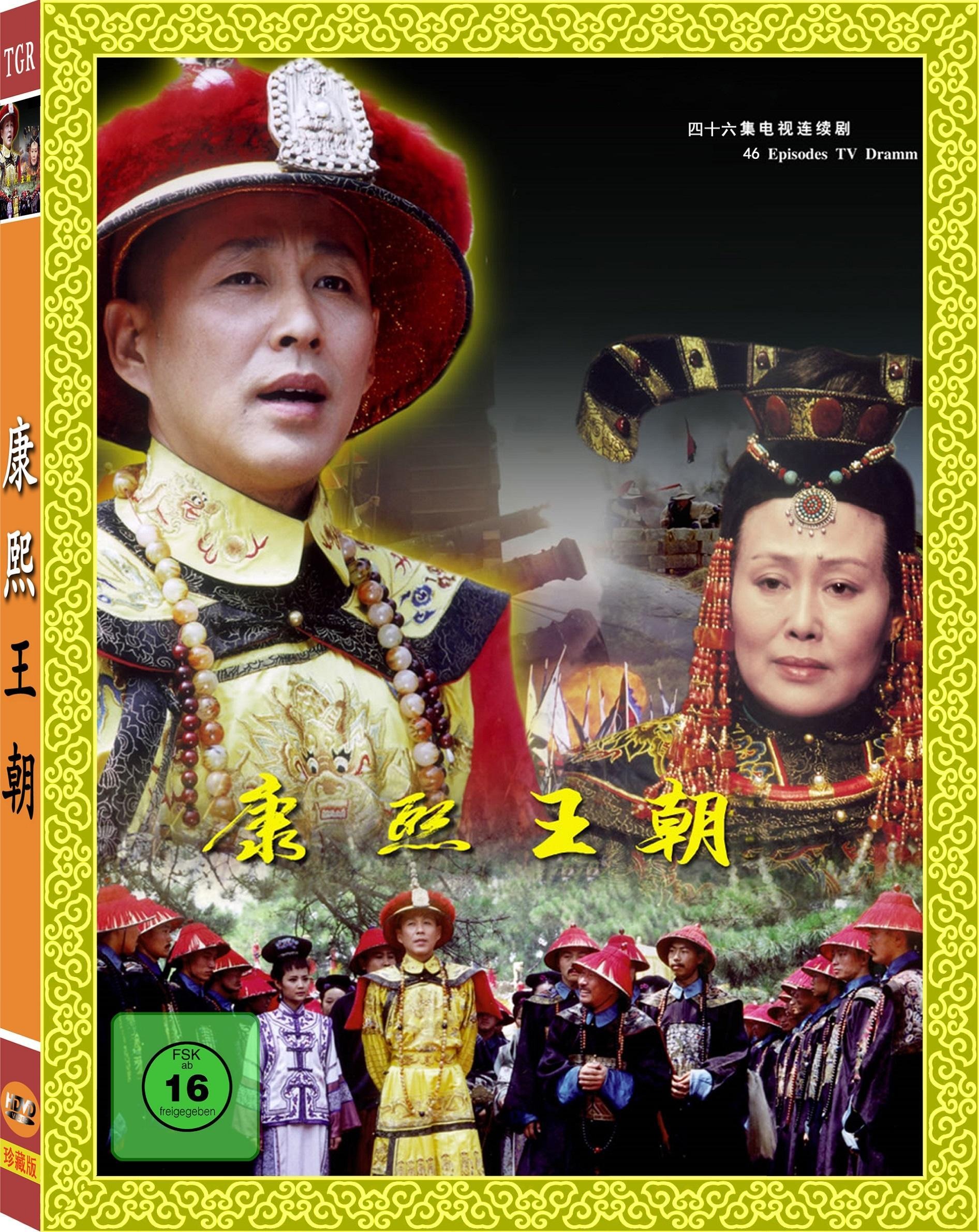
Kangxi (康熙) sat on the Chinese throne for sixty-one years. He ascended as a child, when his father's ministers made decisions for him, and lived to see his own sons begin to fight over the succession. Television has been especially fond of his journeys to the south. In reality, the emperor took the entire court with him on the road and inspected dams and canals, while in the series Kang Xi Incognito Travel he could simply open a shop in Suzhou and, over a bowl of porridge, find out what the local magistrate was up to.
Xuanye (玄烨) was born in 1654 in Beijing's Forbidden City. His father, the Shunzhi Emperor, died of smallpox in 1661. Xuanye, who had already survived smallpox himself, took the throne before he had turned seven. The first year of the Kangxi reign era was 1662. Under his father's will, four regents governed on the boy's behalf. In 1667 Xuanye formally assumed power, but the most influential of the regents, Oboi, still had his own people at court. Two years later Kangxi ordered Oboi's arrest and removed his supporters.
In 1673 Kangxi decided to abolish the domains of the three feudatory princes, to whom the Qing had once entrusted the holding of the conquered south. Wu Sangui, who ruled in Yunnan, was the first to raise troops. The princes of Guangdong and Fujian joined him. Wu Sangui himself died in 1678, having managed to proclaim himself emperor, and his troops fought on for another three years. In 1683, off the Pescadores, the Qing fleet under Shi Lang crushed the forces of the Zheng house, which ruled Taiwan. After the Zheng surrender, Taiwan was placed under Fujian province.
In the northeast, the dispute over lands in the Amur region ended with the Treaty of Nerchinsk in 1689. The treaty determined where the border with Russia would run in that sector and set the rules for trade. The Qing envoys at the negotiations were assisted by two Jesuits, who translated into Latin. Kangxi had dealt with European missionaries back in his youth. At the end of 1668 he demanded that the astronomer Ferdinand Verbiest demonstrate in practice how his predictions could be verified. Verbiest proposed calculating in advance the length of the shadow cast by a rod. For three days running at noon his calculations were checked against measurements. Verbiest's rivals proved unable to predict the length of the shadow.
From 1684 to 1707 Kangxi traveled south six times. He inspected dikes and canals and met with local scholars and officials. During the second journey, in 1689, Kangxi climbed Mount Tai, where Chinese emperors had since ancient times worshipped Heaven. The route from Beijing to the cities of the Yangtze delta and back covered more than three thousand kilometers. The emperor was accompanied by his family, officials and thousands of soldiers, and hosting the court cost the local authorities enormous sums. On his return Kangxi ordered the journey to be recorded on silk. The painter Wang Hui and his assistants filled twelve large scrolls, nine of which survive. On one of them the emperor, beneath a yellow umbrella, surveys the surroundings from the wall of Jinan, while townspeople gather at its foot.
Toward the end of the reign, the fiercest arguments at court concerned who would inherit the throne. Kangxi twice stripped his second son, Yinreng, of the title of heir. After the second removal, in 1712, no new heir was ever publicly named, and the emperor's sons formed their own factions at court. When Kangxi died in 1722 at the Changchunyuan suburban residence, the throne passed to his fourth son, Yinzhen, who took the reign title Yongzheng. These are the years in which the opening of The Yong Zheng Dynasty (1999) unfolds, with Jiao Huang playing an aged Kangxi surrounded by grown sons already prepared to fight for power.
In Kang Xi Dynasty (2001) the emperor himself becomes the protagonist. He is played in his youth by Li Nan and in his mature years by Chen Dao-Ming. Oboi's arrest, the war with the princes and the campaign against Taiwan are shown in the series as the young ruler gradually concentrates power in his own hands. Around the same years came The Duke of Mount Deer (2000), based on a novel by Jin Yong. There the young emperor, played by Patrick Tam Yiu-Man, has a friend, Wei Xiaobao, a fictional rogue who passes himself off as a eunuch and ends up privy to court affairs.
In the adventure series Kang Xi Incognito Travel (from 1997 onwards), the emperor goes in disguise, hears complaints in person and deals with corrupt officials. In one episode he even takes up selling porridge to find out what is going on in Suzhou. Zhang Guo-Li played Kangxi for four seasons, and in the fifth, released in 2007, the role passed to John Lone. One of the emperor's real concerns is the subject of The Long River (2022) with Luo Jin. Here the story begins with a flood of the Yellow River, and alongside the emperor at the centre of the action are the men he tasked with tackling the floods.

