


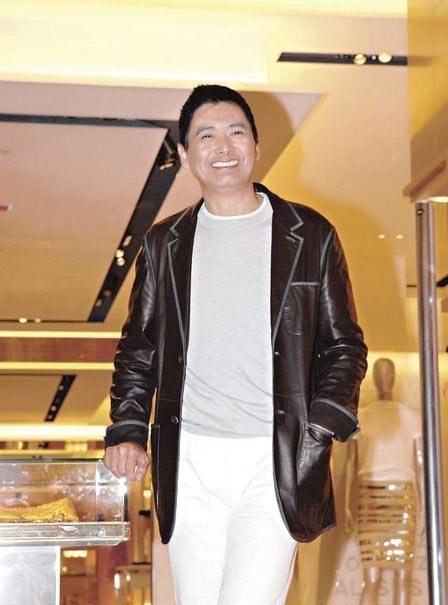
Chow Yun-Fat 周潤發

Lois
May 19, 2003 at 01:04
5 / 17 840

Chow Yun-Fat was born on May 18, 1955, on the small island of Lamma into a poor farming family. In 1965 his family moved to Hong Kong, where his father found work at an oil refinery. At the age of 17, Chow Yun-Fat was forced to leave school to help his parents. Over the course of a year he tried his hand at many trades — postman, courier, bellboy.
Chow Yun-Fat's film debut came in 1976, but went unnoticed. He first drew public attention in 1981 with the role of a South Vietnamese soldier in The Story of Wu-Viet, but personal problems (an unsuccessful marriage to actress Candy Yu) prevented him from seizing the opportunity. The next step forward was the dramatic role of a young man striving at any cost to leave Hong Kong on the eve of the Japanese invasion in 1941, but staying behind to help his friends, in the 1984 film Hong Kong 1941. This work brought the actor recognition from Asian film critics, as well as a Golden Horse Award (Taiwan's equivalent of the Oscar) and the title of Best Actor at the Asia-Pacific Film Festival in Tokyo.
In 1984, during a stay in Singapore, Chow Yun-Fat met Jasmine, the daughter of a local businessman, who has been his wife from 1986 to the present day.
The turning point in his career came in 1985, when Chow Yun-Fat first met director John Woo on the set of A Better Tomorrow. Long dreaming of finding his action hero, Woo saw in Chow Yun-Fat a kindred romanticism, and managed to insist on the actor's casting, which the film's producers opposed. Until that moment, Chow Yun-Fat had tried himself in many roles — he had been a comedian, a romantic lead, and a ruthless mobster — but only in John Woo's films did his signature image take shape: a hitman with two pistols, following his own code of honor and ready to die for friendship. John Woo dressed his knight in a long trench coat and replaced the sword in his hands with a Beretta. Thus another cinema legend was born.
Released in 1986, A Better Tomorrow, in which Chow Yun-Fat played the gangster Mark Gor, a friend of the protagonist Ho (Ti Lung), enjoyed enormous success in Asia and instantly made famous the director and the actors involved in the film. This role brought Chow Yun-Fat the title of Hong Kong's Best Actor of the Year for the first time. In 1987, in the rather unsuccessful sequel A Better Tomorrow 2, Chow Yun-Fat played the twin brother of the character who died in the first part, and in 1989 the producer of the first two installments, Tsui Hark, made a prequel to the story, Love and Death in Saigon, one of whose main characters was again Mark Gor, played by Chow Yun-Fat.
1987 marked the beginning of his collaboration with the second most important director in Chow Yun-Fat's film biography, Ringo Lam, who gave him the opportunity to demonstrate his acting abilities in the gritty prison drama Prison on Fire and the tense action film City on Fire, about an undercover cop infiltrated into a gang of robbers. Subsequently, one of the plotlines of City on Fire formed the basis of Quentin Tarantino's Reservoir Dogs, while Chow Yun-Fat's role went to Tim Roth. For his work in City on Fire, Chow Yun-Fat was named Best Actor of Hong Kong for the second time. Unlike John Woo, who romanticizes his heroes, Ringo Lam was always a proponent of the realistic strand of Hong Kong cinema, yet Chow Yun-Fat is just as essential a part of his cinematic universe. It is symbolic that the actor appeared in an equal number of films by each director — five.
In 1989, John Woo and Chow Yun-Fat's finest film was released, The Killer, a tribute to Woo's beloved directors — Leone, Melville, and Peckinpah. Chow Yun-Fat develops his screen persona of the sentimental killer, and Melville's lone samurai here emerges as a man capable of love and self-sacrifice. Danny Lee, who played the criminal in City on Fire, this time swaps places with Chow Yun-Fat, becoming a policeman. Standing on opposite sides of the law, the heroes cannot overcome their mutual sympathy, discovering a similarity of character, and fight shoulder to shoulder. John Woo transforms an elementary plot that, in summary, resembles the content of an Indian film into an epic narrative about good and evil, bringing his action style to perfection. No less important to the film is the magic of Chow Yun-Fat's screen presence.
In 1989, another popular Chow Yun-Fat hero was born, less known outside Asia than his roles for Woo and Lam — the "god of gamblers" Ko Chun in Wong Jing's God of Gamblers, a kind of Hong Kong variation on con-artist films. The role of Ko Chun gave Chow Yun-Fat the opportunity to prove himself in a comedic register. The story of the master of cards and wizard of mahjong was continued in 1994 in God of Gamblers Returns.
The early 1990s saw the last two collaborations between John Woo and Chow Yun-Fat. In 1991, the amusing adventure film Once a Thief was made, in which Chow Yun-Fat, Leslie Cheung, and Cherie Chung played inseparable friends specializing in stealing works of art. In 1992 came Hard-Boiled, a benchmark for the Hong Kong urban action film, starring the duo of first-rate Asian stars Chow Yun-Fat and Tony Leung Chiu-Wai in the lead roles.
After appearing in his last Hong Kong film, the actioner The Peace Hotel in 1995, Chow Yun-Fat attempted to continue his career in Hollywood. On the eve of Hong Kong's handover to China, many Hong Kong filmmakers moved to the United States in the mid-1990s, but their lot was often only B-grade action films and television product. Chow Yun-Fat had to contend not only with the problem of learning English; the main obstacle proved to be producers' stereotyped notion of his persona, based solely on Woo's films. In the actor's first American project, Antoine Fuqua's The Replacement Killers, released in 1998, Chow Yun-Fat again had to play a hired killer who gets into trouble. Despite a decent cast that also includes Mira Sorvino, Michael Rooker, and Til Schweiger, the film itself leaves the impression of a student imitation of an average John Woo action film. The next film, James Foley's The Corruptor (1999), turned out little better, in which Chow Yun-Fat appeared before viewers as a corrupt policeman initiating his young colleague (Mark Wahlberg) into the ways of the trade.
In 1999, a large-scale adaptation of Anna Leonowens's diaries was released in cinemas, Andy Tennant's costume melodrama Anna and the King, in which Chow Yun-Fat was given the leading male role, King Mongkut of Siam, who invites an Englishwoman (Jodie Foster) to teach his children. Unfortunately, this film, which showed Western audiences another side of the actor, did not help expand the range of roles offered to him. The problem of the English language, which Chow Yun-Fat finds very difficult, also remains relevant.
Ironically, Chow Yun-Fat might never have taken part in his finest project in years, as he was reluctant to play a supporting role in a martial arts film in a language he barely knew. The film in question is Crouching Tiger, Hidden Dragon, shot in Mandarin Chinese (Chow Yun-Fat's native tongue is Cantonese). But after Jet Li turned it down, he could not resist the chance to work with director Ang Lee and was cast as Li Mu-Bai. Bringing together Asian stars of different generations (the film also features Malaysia-born Michelle Yeoh, young Chinese actress Zhang Ziyi and Taiwan-born Chang Chen), Crouching Tiger, Hidden Dragon showed audiences around the world the possibilities of the traditional Asian wuxia genre. A beautiful, sad fairy tale about the tragedy of people trying to hide their true feelings from one another and follow their duty, it once again proved that real cinema can handle any genre, and fantasy is no exception. Although Chow Yun-Fat's and Michelle Yeoh's characters are given less screen time than Zhang Zi-Yi's, it is Li Mu-Bai who is the centre of the narrative. The role of the wise swordsman who, in the last minutes of his life, regrets rejecting the love of someone close to him, is played by Chow Yun-Fat with restraint and a sense of his own dignity.
Chow Yun-Fat's most recent film to date is the comic book-based Bulletproof Monk, whose reviews do not inspire optimism. But one wants to believe that John Woo's long-awaited new film, scheduled for 2004 with Chow Yun-Fat in the lead, will still make it safely to audiences and will not disappoint fans of the actor and the director.




Ребята, помогите найти основную тему из Чой Юн Фатовского фильма "БОг азартных игроков"
Спасибо
в новом фильме с режиссёром Джонни То который тоже снял
фильм "Выборы" и "Выборы 2" но я сам хочу узнать как будет
называться фильм и какие актёры с Чоу Юнь Фатом снимуться
вместе с ним а он снялся вместе с Николасом Кейджом который
хотели сняться в вестерне, но ещё с Марком Дакаскосом вы
сами не знаете а я ещё знаю что Чоу Юнь Фат снялся с режиссёром Энн Хуй "Постмодернистская жизнь моей тёти"
но сами напишите мне чтобы я узнал?