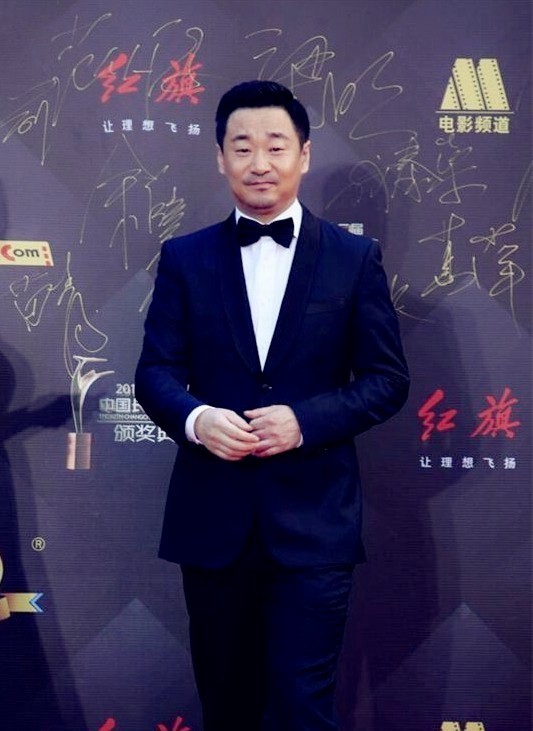
Wang Jing-Chun 王景春


Wang Jing-Chun has played police officers so many times that in China he has long been regarded as a specialist in that department. In the series Ordinary Greatness, he played a station chief whose days are consumed by settling neighbors' quarrels and training rookies. But his best-known role came as a factory worker in Wang Xiao-Shuai's family drama So Long, My Son. After his son's death, his character moves with his wife to a fishing village and makes a living as a welder. Wang had learned the trade before he ever enrolled in a theater academy.
Wang Jing-Chun was born on February 12, 1973, in Altay, in northern Xinjiang, into a military family. His father served on the border for seventeen years and was often away for long stretches, so Jing-Chun and his younger brother were raised mainly by their mother. His parents spoke fluent Kazakh and, as the actor recalled, would sometimes switch to Kazakh when they wanted to whisper about something. His father had many friends among the local herders. They would ride up and sometimes stay with the Wangs for several weeks. In 1986 his father was transferred to Urumqi. When, before leaving, he went into the mountains to say goodbye, his acquaintances waited for him by the road to invite him into their homes and treat him to mutton.
At school Jing-Chun sang, performed in recitation competitions and acted in skits, and in the fifth grade he even appeared on local television. He trained as a welder, and after technical college he got a job at a Xinjiang department store, where he first did publicity work for the trade union and later sold children's shoes. One day, at a rehearsal for a skit, he met Lang Chen, a director at the Tianshan Film Studio. Lang suggested he try applying to a drama school. For about three years Wang would go to Lang Chen's home after his shift to watch films and act out études. By another account, the lessons began in 1993, roughly two years before he was admitted. Wang entered the Shanghai Theatre Academy in 1995. It took him a long time to get used to Shanghai. For the first two years, he said, he waited all week for the weekend, when he could go to a Xinjiang restaurant and have a proper meal.
Wang began acting while still a student, and in 1999, right after graduating, he joined the acting troupe of the Shanghai Film Studio. He considers his first leading film role to be that of a soldier in On the Road (旅途), shot that same year in Xinjiang. The film was based on an incident on an intercity bus: a soldier helped the passengers fight off robbers. In the years that followed there was plenty of work, especially on television, where he was cast, for example, as Jiang Wenbin in the sitcom Du Shi Nan Nv. He received his first award in April 2010. For his role as Ning Wuyuan, head of a major crimes unit, in the TV film Crazy Rose (疯狂的玫瑰, 2009), he was presented with the Lily, an award from the CCTV-6 movie channel. Some publications date the award to 2009, but the ceremony took place in 2010. To prepare for the role, Wang hung photographs from crime scenes on the walls of his room, read the materials investigators gave the crew, and learned to distinguish fingerprints.
The actor first worked with Wang Xiao-Shuai on the drama 11 Flowers (2011). There he played the father of a boy growing up in a small town in the final years of the Cultural Revolution. While shooting the drama about the aftermath of the Sichuan earthquake, Smile Walked (2012), Wang broke his leg in a chase scene and kept acting, moving between takes on crutches. There he met Li Jing, who made sure the details matched from take to take. A friend of the couple told the Chengdu Wanbao newspaper that Li Jing helped Wang with his bandages and later traveled with him to London for a screening of 11 Flowers. At the time he was still getting around in a wheelchair. In January 2015 Wang and Li Jing registered their marriage in Shanghai, in March they held a wedding in her native Chengdu, and in June their daughter was born.
In Ning Ying's drama To Live and Die in Ordos (2013), Wang played a police chief from Inner Mongolia. In the premiere materials the character is called Hao Wanzhong, like the real-life prototype. In some publications the character has a different name – Na Wuchang (那五常). After Hao's death, dozens of his work diaries remained, and the filmmakers used them to reconstruct the course of his investigations. Wang questioned Hao's colleagues and relatives, studied the local dialect and, by his own account, gained a little over ten kilograms (by other reports, about ten) to resemble him. The hardest part, he said in an interview, was acting alongside non-professional actors, who made up the majority of the cast. Against them, any hint of affectation would have stood out immediately. In October 2013 Wang was awarded the Best Actor prize at the Tokyo International Film Festival.
Between the summer and winter shoots of the thriller Black Coal, Thin Ice, Wang managed to slip away to Inner Mongolia to film To Live and Die in Ordos. Back in Harbin, he discovered that his friend Liao Fan had also put on weight for his role. In Diao Yi-Nan's film, Wang played the owner of a dry cleaner's where works the woman tailed by Liao Fan's character. In 2014 the two of them traveled together to Berlin, where the film won the Golden Bear and Liao Fan took the acting prize. Both pictures opened in Chinese cinemas on the same day, March 21.
Wang remained happy to take on supporting roles. In the thriller Explosion (2017) he played Xu Feng, head of a criminal investigation unit. The protagonist has known him since childhood but keeps his distance: Xu Feng once sent him to prison. Zhang Yi-Mou, for whom Wang had already played a soldier in The Flowers of War (2011), invited him into his historical picture Shadow (2018). There Wang played the courtier Lu Yan, whose intentions remain unclear for a time. Back in 2015, Wang and Liao Fan had founded an arthouse cinema center in Shanghai, and in 2018 they mounted a Zhang Yi-Mou retrospective.
When Wang Xiao-Shuai invited him to star in So Long, My Son (2019), he was to play Liu Yaojun, whose story in the film spans three decades. Before shooting, he and the director met families who had lost an only child. For the scenes in which Yaojun is still young, the actor lost fifteen kilograms, and before filming the factory episodes he once again spent time on the shop floor. Together with Yong Mei, who played Yaojun's wife, Wang improvised a great deal on set. In one scene at the table, for instance, someone jokingly offers three peanuts as a reward. Such lines, according to Wang, were born once the camera was already rolling. And the nighttime scene in which Yaojun runs with his wife in his arms took five days to shoot. On the third day Wang injured his left arm, and by the final take, as he recalled, he could barely lift it.
At the 2019 Berlinale, both Wang and Yong Mei received Silver Bears for their leading roles. In his speech Wang remembered his late father and dedicated the award to his daughter, thanks to whom, he said, he had come to understand how good it is to be a father. In the autumn he and Yong Mei shared a stage once more when both were awarded the Golden Rooster. The following year, in the series The Bad Kids (2020), Wang played Chen Guansheng, a neighborhood policeman nearing retirement. In the story of three children who accidentally film a murder on camera, old Chen has troubles of his own. He is searching for the son of an old acquaintance and trying to set the boy's life on course.
In 2022 two series premiered at once in which Wang played policemen. In The Fight, his character Wen Luyang handles a criminal gang case and looks for the gang's accomplice within his own department. In the series Ordinary Greatness, Wang Shouyi, the head of a police station, welcomes new recruits and teaches the young officers how to handle the complaints that neighborhood residents bring in every day. For this role, by his own account, the actor trailed a real station chief, listened in on his conversations and observed how he carried himself with his subordinates. In the very first scene he had to talk to eleven fellow actors in a single long take. The role earned him China's Golden Eagle television award for Best Supporting Actor in 2024. That same year Wang again played a detective in the series Let Wind Goes By, where a woman's death draws his character back to a long-unsolved case in a mining town. And in the drama New Life (2025) he played the widower Zhao Bujin, who takes to drink after his wife's death and gradually drifts away from his daughter.