


Wang Hsieh 王俠


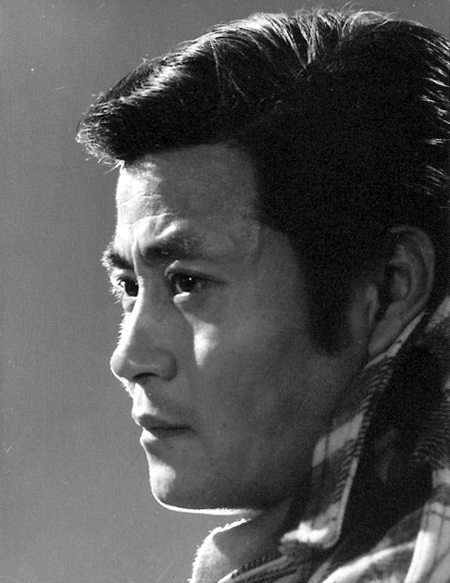
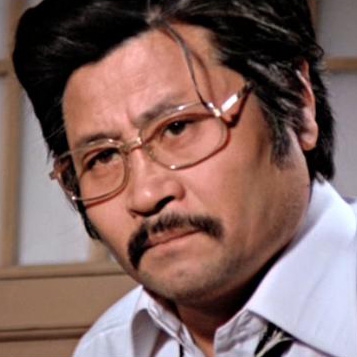
At Shaw Brothers, Wang Hsieh often played men used to giving orders. Tall, broad-shouldered and thickly bearded, he easily passed for a gang boss or an old master no one dared to contradict. In Killer Clans he headed one of the warring clans, while in The Super Inframan he played, with the same gravity, a professor who turns a volunteer into a cyborg so that he can fight monsters. Wang Hsieh spent twelve years at the Hong Kong studio, but began and ended his career in Taiwan, where he was already known for black-and-white melodramas.
Wang Hsieh was born in Xi'an, in Shaanxi Province, and moved to Taiwan with his father. The Taiwanese film yearbook and obituaries give his date of birth as 5 May 1930, while the HKCinema catalogue lists 5 March of the same year. According to Chua Lam and the Taiwanese press, his real name was Wang Zhenzhao (王振釗); the film yearbook gives the variant Wang Zhengang (王振剛), and IMDb lists Chang Chien Wang. In his youth he entered the Republic of China Air Force Academy, but according to the Taiwanese press he left his studies for health reasons. After leaving the academy, he performed with the Lixing drama troupe and then found work at the Asian Film Company.
Wang Hsieh's first films were in Taiwanese, a language which, by producer Chua Lam's recollection, he never quite mastered. What saved him was that the studio dubbed the dialogue after shooting. In Death in West Bay he appeared opposite the actress Xu Yu, his future wife. The shoot was announced as early as 1957. The Taiwan Film Archive dates the film to 1959 and cites release advertisements from early that year, while the HKCinema catalogue lists 1958. In 1959 the director Pan Lei gave Wang Hsieh a prominent role in the drama Golden Years (金色年代). The film was already shot in Mandarin, and afterwards the actor was increasingly invited to appear in pictures in that language.
Pan Lei also cast Wang Hsieh in the first two films he made for Shaw Brothers. Both were shot in Taiwan. For Lovers' Rock (1964) the director chose fishing villages, and for Song of Orchid Island (1965) he took the crew to Orchid Island, where Wang Hsieh played the son of the local chief. In 1965 the actor signed a contract with the studio and moved to Hong Kong. Riding the Bond craze, the studio was then eager to make spy films. In Poisonous Rose (1966), again by Pan, he got one of the leading roles: he played Kang Hua, whose affairs a nightclub singer tries to find out about. In Asia-Pol (1967), a co-production between Shaw Brothers and Japan's Nikkatsu, he played Lai Yu-Tian. In the Japanese version, released in December 1966, his character is presented as a hired killer. In The Black Falcon (1967) he plays a criminal with a scar on his cheek.
In the period martial arts films that by the early 1970s had come to occupy a special place in Shaw Brothers' output, Wang Hsieh quickly became a fixture. He had broad shoulders and a heavy gaze, and the thick beard he often wore on screen made him look older than he was. In The Lady Hermit (1971) he played the chief villain, who tries to lure the heroine out of hiding by staging attacks in the guise of deadly ghosts. Two years later the same director, Ho Meng-Hua, cast him in The Master of Kung Fu (1973). This time Wang Hsieh played the bandit Li Tian-Dao, who is hired as bodyguard by a foreign merchant. He engineers the poisoning of a rival and pins the blame on Wong Fei-Hung, played by Ku Feng, and later plots to rob his employer.
Wang Hsieh often appeared in Li Han-Hsiang's films. In The Warlord (1972), a satire set in the era of the Chinese warlords, he played a commander who leads soldiers to loot a tomb. In the middle of the decade he appeared for Li in two palace dramas about the last years of the Qing dynasty – The Empress Dowager (1975) and The Last Tempest (1976). 1975 also saw the release of The Super Inframan, made at Shaw Brothers on the model of Japanese superhero series. Wang Hsieh's scientist carries himself so earnestly that he might be going about ordinary lab work, even though he is about to turn Danny Lee's hero into a cyborg capable of dealing with monsters.
Shortly before leaving Shaw Brothers, Wang Hsieh appeared in two wuxia films by Chor Yuen, both released in 1976. In Killer Clans he plays the head of the Roc Clan, a longtime rival of Uncle Sun. In The Web of Death, his character, the leader of the Five Venoms Clan, has to keep his own people in check when they want to unleash the clan's old weapon – a poisonous spider.
In 1977 Wang Hsieh left Shaw Brothers and returned to Taiwan. There he continued to appear in action films, among them the thoroughly traditional The Three Famous Constables (1983) and Wolf Devil Woman (1982, listed as 1981 in some filmographies), in which the heroine is raised by wolves. He was still being invited to appear in Hong Kong as well. In The Prodigal Son (1981) by Sammo Hung he played a Qing prince so fearful for his son that he orders his bodyguards to dispose of any fighter capable of defeating the young man in a duel. In A Better Tomorrow (1986) by John Woo he appeared in a small role as a Taiwanese mobster. During a deal in Taiwan, Ti Lung's character is ambushed and then imprisoned. By 1996, according to CNA, Wang Hsieh had appeared in more than one hundred and fifty films.
Wang Hsieh had been working in Taiwanese television since the 1980s. In Shen Diao Xia Lu (1984) he played Huang Yaoshi, the unsociable master of Peach Blossom Island from Jin Yong's novel. When this character first appeared, he was played by Jiang Dachuan. Toward the end of his career Wang Hsieh appeared in several youth series. In Hot Shot (2008), a story about college basketball, he played Dongfang Shuo, the grandfather of one of the players. Then came small roles in Love Buffet (2010) and What Is Love? (2012).
Wang Hsieh and Xu Yu had four children. One of their sons, the future singer Dave Wong, lived as a child with his father in Shaw Brothers' fourth dormitory on Clearwater Bay Road. At the studio he was given small roles, including in The Eunuch (1971), in which his father also appeared. As Dave Wong recounted, after his parents' divorce he stayed on at a Hong Kong boarding school and worked as a cleaner to pay for his studies. In 2025 the Hong Kong publication HK01 cited the recollections of one of his dormitory neighbours, Danny Lee. According to him, Wang Hsieh often beat his son for misdeeds. Father and son went long periods without speaking. Chua Lam, who invited Wang Hsieh to appear in Killer's Nocturne (1987), recalled in a column for Apple Daily a conversation about his fee. The money offered was modest, and Wang Hsieh said it would be enough for an electric guitar for his son. In 2004 the actor came to Dave Wong's fan meeting in Taiwan and brought his son his favourite dumplings. According to Taiwanese press reports, they grew closer after that.
Wang Hsieh met his second wife, Yang Wen-Ying, when she came from Sichuan to Taiwan to visit relatives. They married in the mid-1990s and, according to Yang Wen-Ying, were married for 21 years. She recalled how her husband would sew the buttons back on himself when they fell off and sort her medicines into little boxes. In 2016, the China Times revived an old rumor that Wang Hsieh was living on a monthly allowance of three thousand Taiwan dollars while his son did not help him. At the time, Wang Hsieh defended his son, saying that without his help he would have been lost long ago. According to his wife, the actor's cancer was discovered about eight months before his death. Dave Wong visited him during his treatment, while at home his wife cared for him. Wang Hsieh died in Taipei on July 21, 2016, at the age of 86. According to a CNA report, he was 87. CNA and other outlets gave pancreatic cancer as the cause of death, while the Taiwan Cinema Yearbook lists lung adenocarcinoma. On learning of his father's death, Dave Wong wrote that he had not had time to say goodbye and asked his forgiveness.


Кстати, тут Дэйв Вонга записать надо в семью)